

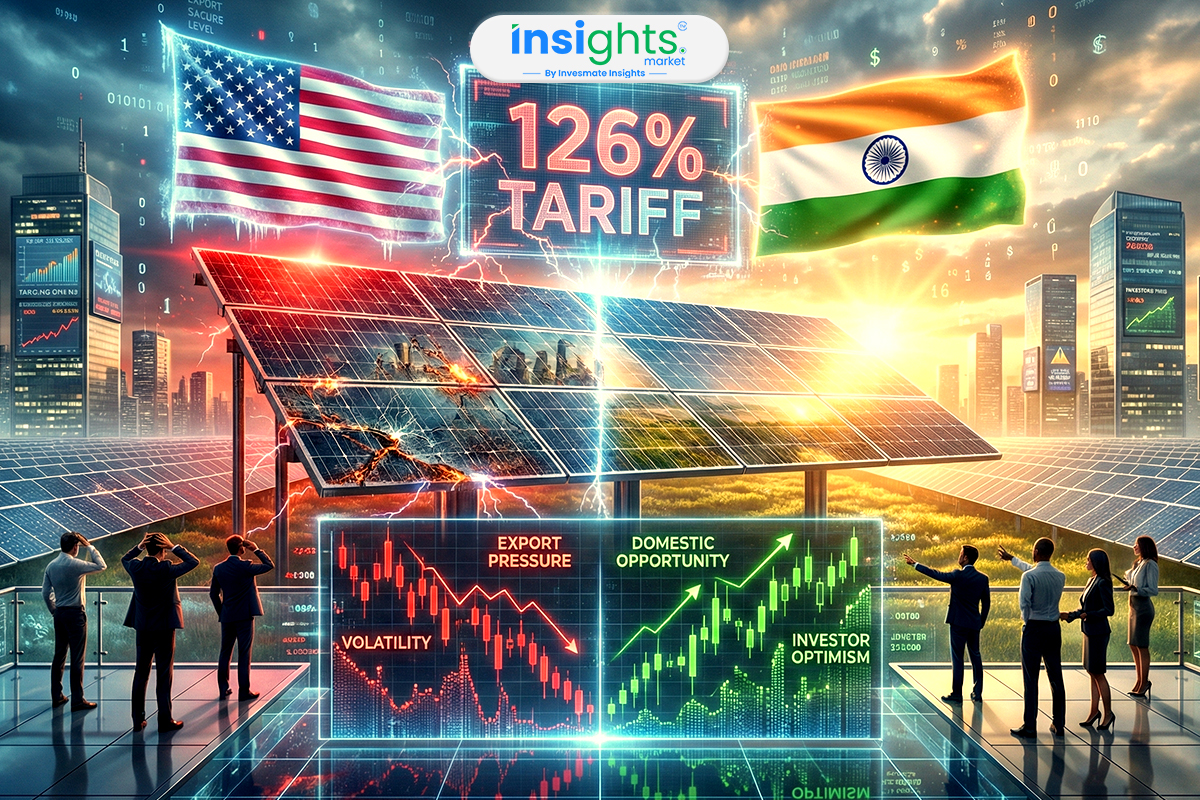

On February 25, Indian solar stocks saw sharp selling pressure after news broke that the United States imposed a preliminary 126% countervailing duty on Indian solar imports.
Shares of Waaree Energies and Premier Energies fell nearly 10–15% in a single session, wiping out significant market capitalization.
The trigger? A U.S. trade action that directly hits a market absorbing 97–99% of India’s solar module exports over the past two years.
For investors, this is not just another headline.
It raises serious questions about:
- Export dependency
- Revenue visibility
- Margin sustainability
- Capacity utilization
But beneath the immediate panic, the bigger question is:
Is this the beginning of a structural slowdown for Indian solar manufacturers — or the start of a strategic reset?
Let’s break it down.
What Exactly Happened?
The U.S. Department of Commerce announced a 125.87% preliminary CVD on crystalline silicon solar cells and modules imported from India.
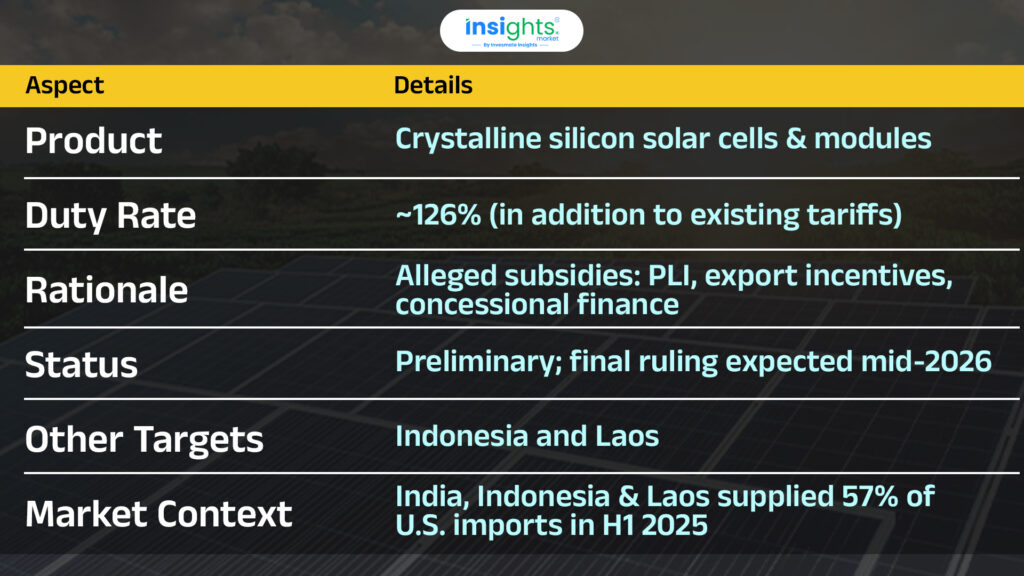
A 126% duty effectively doubles the landed cost of Indian solar modules in the U.S., making exports commercially unviable at current price levels.
Investor takeaway: This is not a temporary trade spat. It signals a structural shift in U.S. trade policy toward Indian solar imports.

Why Did the U.S. Impose This Duty?
1. Protecting Domestic Manufacturing
Despite the Inflation Reduction Act (IRA), the U.S. remains import-dependent.
- U.S. imported 54.3 GW of finished solar panels in 2024
- Annual installation demand ~40 GW
- Domestic capacity still ramping up
Policymakers want to protect nascent U.S. manufacturers.
2. Anti-Subsidy Enforcement
U.S. authorities argue Indian manufacturers benefit from:
- PLI incentives
- Export rebates
- Preferential financing
Similar action was previously taken against China and Southeast Asia.
3. China+1 Strategy Backfire
India’s exports to the U.S. surged 23× between FY2022–FY2024, reaching ~US$2 billion.
Over 97% of India’s exports went to the U.S. in FY2023–24.
Indian modules are estimated to be 19–21% cheaper than U.S.-made modules.
The very success of India’s export boom triggered a protectionist response.
4. Election-Year Trade Politics
Solar tariffs align with:
- Climate goals
- Domestic job creation
- Industrial policy focus
This reflects a broader U.S. shift toward protectionism.
India’s Extreme Export Concentration Risk
PV Module Export Data
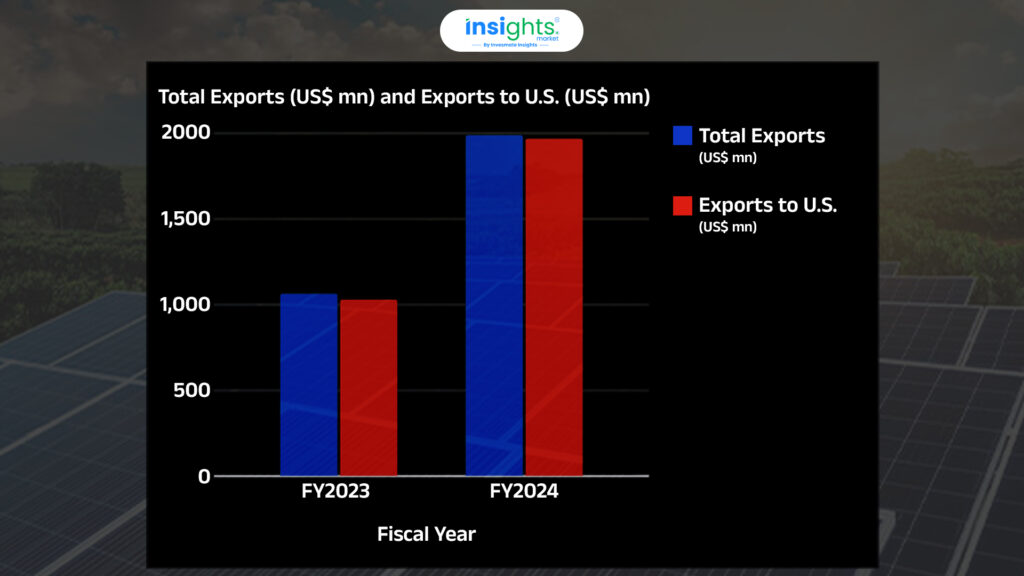
Additional Data:
- Export value rose 23-fold between FY2022–FY2024
- India exported 5.8 GW in FY2024 (3× FY2023)
- Other markets accounted for just 1–3%
- India’s share of U.S. imports rose from ~3% (2022) to ~11% (2024)
Investor implication: A near single-market export model creates binary risk. If U.S. access closes, diversification is minimal.
India’s Domestic Solar Story: The Safety Net
Solar Capacity Growth
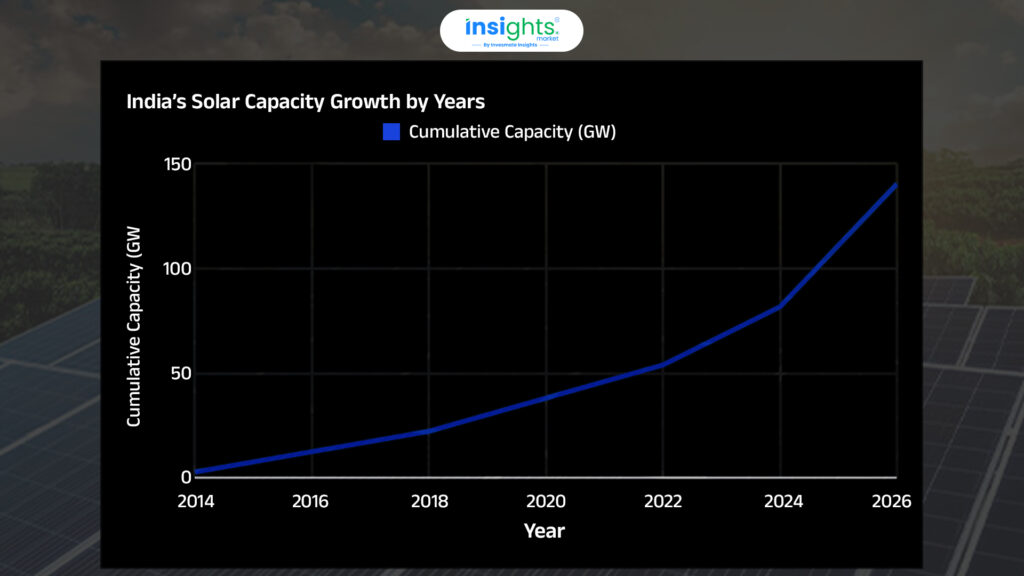
India’s solar capacity has grown nearly 50-fold since 2014.
Total renewable capacity reached ~209 GW by Dec 2024, growing 15.84% YoY.
Policy Support
- PLI for manufacturing
- ALMM framework
- PM Surya Ghar rooftop scheme
- 500 GW non-fossil target by 2030
Investor insight: Companies with strong domestic pipelines face lower structural risk than pure export plays.
Impact on Indian Solar Companies
1. Export Dependency Risk
- ~97% of exports went to the U.S.
- Calendar 2024 exports ~US$793 million
- 600–1,000 MW reportedly at risk
Company exposure varies:
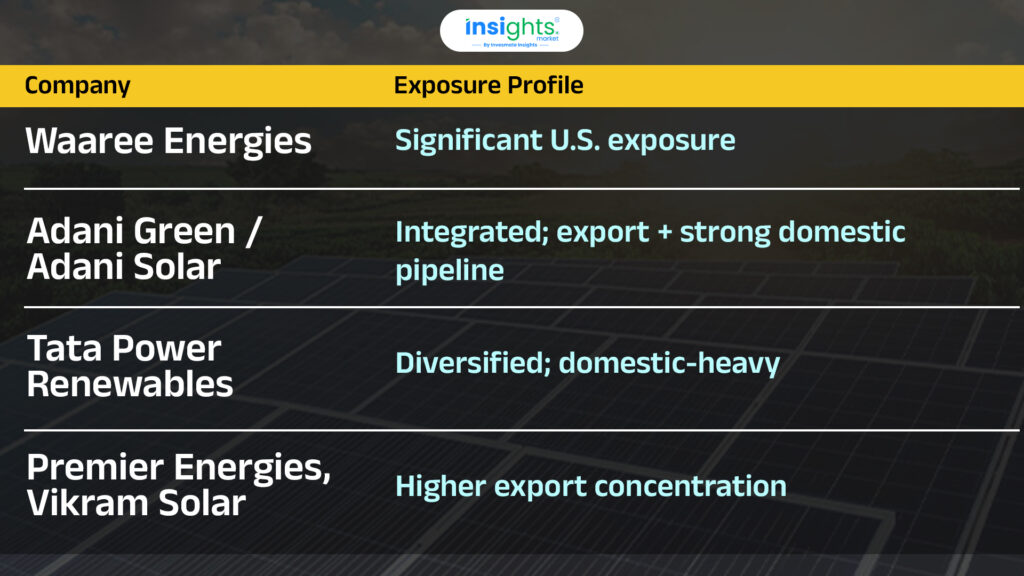
Action: Identify each company’s U.S. export share as % of revenue.
2. Margin Pressure
Three scenarios:
- U.S. buyers switch suppliers
- Indian exporters absorb duty (margin compression)
- Overseas manufacturing pivot
At 126%, direct exports are largely commercially unsustainable.
3. Capacity & Order Book Risk
India has sanctioned 100+ GW module capacity, exceeding domestic installation rates.
With U.S. access uncertain:
- Utilization may fall
- Order renegotiations likely
- Domestic pricing pressure may intensify
Inventory build-up risks

Is This a Hidden Opportunity?
Three structural opportunity angles:
- Accelerated domestic pivot as India adds tens of GW annually
- Export diversification toward EU & Middle East
- Overseas manufacturing strategy to bypass tariffs
For strong balance-sheet players, this shock could trigger strategic upgrades.
What Should Investors Track Now?
- % revenue from U.S. exports
- U.S.-specific order book revisions
- FY2026–27 guidance changes
- Capacity utilization trends
- Inventory & working capital
- Capex shifts & overseas expansion plans
- Government response & WTO developments
- Final U.S. ruling (mid-2026)
Create a tracking matrix:

Risks vs Opportunities
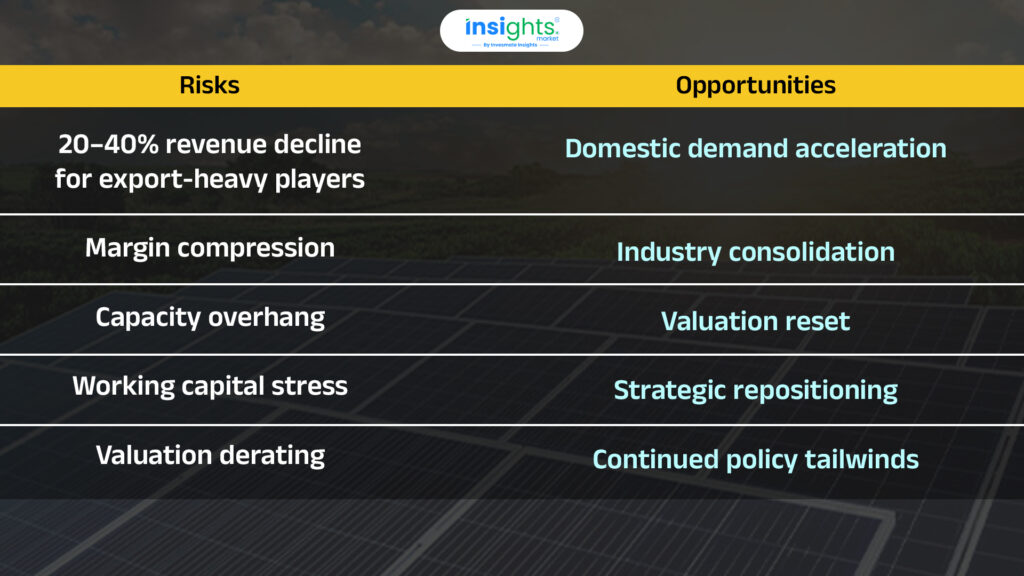
Conclusion
The 126% U.S. solar tariff on India is clearly negative in the short term for export-heavy manufacturers.
But the structural Indian renewable energy story remains intact:
- Solar capacity: 2.8 GW → 140.6 GW
- Renewable capacity: 209+ GW
- Strong PLI and policy support
This is now a stock-picker’s market.
Companies with diversified revenue, domestic strength, balance-sheet resilience, and strategic agility may emerge stronger.
The tariff is both a crisis and a catalyst.
The next 12–18 months will determine which Indian solar companies adapt — and which struggle.
FAQs
Solar stocks like Waaree Energies and Premier Energies fell 10–15% after the U.S. imposed a preliminary 126% tariff on Indian solar imports. Since 97–99% of India’s solar exports go to the U.S., investors reacted to potential revenue and margin risks.
The U.S. Department of Commerce imposed a 126% countervailing duty (CVD) on Indian solar cells and modules, alleging unfair subsidies such as PLI incentives and export benefits. This duty makes Indian solar exports significantly more expensive in the U.S. market.
Export-heavy companies with high U.S. revenue exposure — such as Waaree Energies and Premier Energies — face higher near-term risk. Companies with strong domestic pipelines may see relatively lower impact.
In the short term, earnings and margins may come under pressure. However, in the long term, companies with diversified markets, strong balance sheets, and domestic focus could adapt and stabilize.
It depends on company-specific exposure. Investors should assess U.S. export dependency, order book strength, and domestic growth potential before considering fresh positions.
The duty is currently preliminary. A final ruling is expected around mid-2026, which could confirm, revise, or withdraw the tariff.
This article is for educational and informational purposes only. It is not investment advice or a stock recommendation. Investors should conduct their own research or consult a qualified financial advisor before making investment decisions.