



Have you noticed something strange lately? The Nifty 50 index reached 26,000 just last week, but it has now returned to 25,000. Your investment apps show green days and red days swinging like a seesaw. Everyone from your office friends to your YouTube recommendations is talking about whether the Indian stock market is in a bubble. Let’s cut through the noise and see what the actual numbers tell us.
The Headline Trick: Why Nifty 50 Looks Fine (But Isn’t the Full Story)
At first glance, the Nifty 50 doesn’t seem expensive. It trades at about 22.5 to 23 times earnings, which is only slightly above its long-term average of around 20 times. On paper, this suggests valuations are still within a comfortable range.
However, this headline number hides a bigger issue.
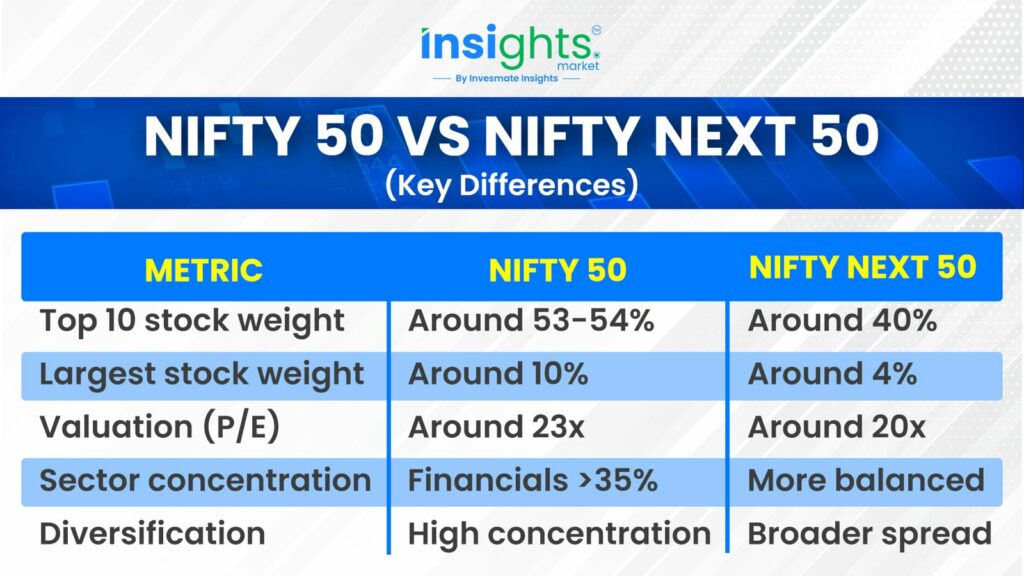
Nifty 50 can seem fairly valued at first glance. Much of its movement comes from a small number of large stocks and a significant focus on financials.
In contrast, the Nifty Next 50 spreads its exposure more evenly across different companies and sectors. It has lower reliance on single stocks and offers relatively better valuations. This makes it a useful option for diversifying in large-cap passive investing, rather than replacing the Nifty 50.
The Real Danger Zone: Midcaps and Smallcaps Are in Trouble?

If the Nifty 50 hides risk through concentration, midcaps and smallcaps conceal risk through high valuations.
The recent drop in midcap and smallcap stocks is mostly due to profit booking and a decreased risk appetite, not a breakdown in long-term fundamentals. When valuations are high and global uncertainty rises without fresh triggers, investors often exit high-beta stocks first, which usually include midcaps and smallcaps.
Midcap stocks are currently trading at 32 to 33 times earnings, about 40% above their historical average, while smallcaps are close to 28 to 29 times earnings, nearly 70% above long-term norms. To put it plainly, it’s like paying ₹850 for something that usually costs ₹500.
These valuations would be easier to defend if earnings growth were speeding up. But it hasn’t happened. In 2025 so far, smallcap indices have fallen nearly 9-11%, even as large caps have shown positive returns. Prices rose ahead of fundamentals, and now the gap is correcting.
Another clear sign is the widening gap between headline indices and the broader market. While benchmarks look resilient, many midcap stocks are struggling at their own levels, indicating a shift towards a more selective market.
This phase should be seen as a reset after a sharp rally, not the end of the midcap or smallcap story. However, it does require discipline—phased investing, a focus on quality, and patience rather than chasing momentum.
The Wealth Transfer Nobody’s Talking About
Here’s something alarming that most retail investors overlook. In Q1 FY26 (June 2025), company promoters sold about ₹55,000 crore worth of shares.
In simple terms, the people running these companies are selling their own stocks at high prices, while regular retail investors like you and me are buying through mutual fund SIPs.
This trend has been called a “Systematic Wealth Transfer from India’s middle class to the rich.” Promoter selling has coincided closely with strong SIP inflows from retail investors. This means your monthly SIP money is arriving just as promoters are exiting.
Why is this happening? Because insiders who know the companies think valuations have gone too high. They are cashing out while retail investors, swayed by growth stories and YouTube videos, keep buying.
Foreign Investors Are Quietly Exiting
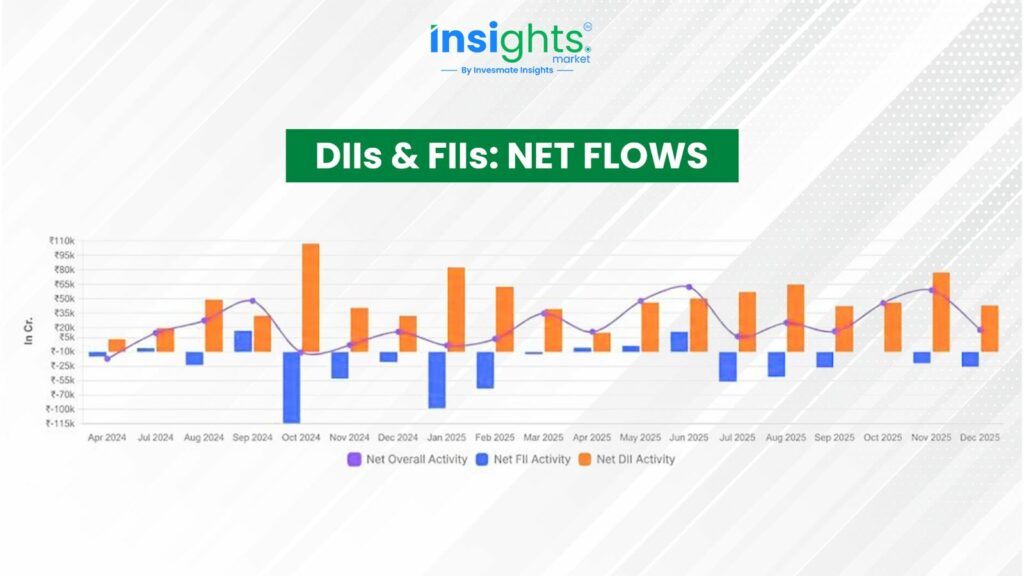
Another red flag: foreign institutional investors (FIIs) have seen sharp bouts of selling in 2025, and have been consistent net sellers for much of the year. Meanwhile, domestic institutional investors (DIIs) – mainly mutual funds receiving your SIPs – have been buying to offset this selling.
Think of it this way: international investors have access to stock markets worldwide. They’re choosing to reduce exposure to India and invest elsewhere. Local retail investors, limited to Indian options, continue buying. When smart money leaves and retail money stays, it usually means valuations are not very comfortable.
The IPO Market: From Opportunity to Lottery
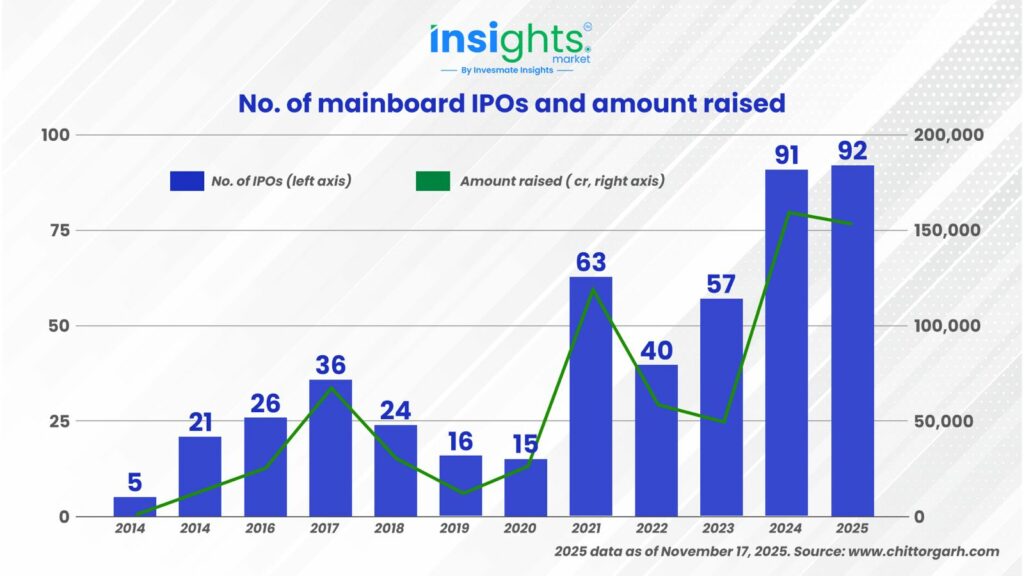
The primary market, where new companies list, is sending out a huge warning signal. In 2021, newly listed IPOs gained an average of around 30-34% on the listing day.
Today, average listing day gains have dropped to around 8 to 9%. Even more concerning, about 40% of IPO companies in 2025 have listed with losses, while many others have shown only minimal gains.
Yet companies keep rushing to the market, and investors keep applying. This combination of high activity but weak returns is a classic late-cycle signal.
It’s like a lottery: people keep buying tickets even though the odds are getting worse.
Read More: IPO Investing Risks 2025:The Hidden Risks Retail Investors Ignore
Interest Rates Are Falling (But That’s Not Helping Much)
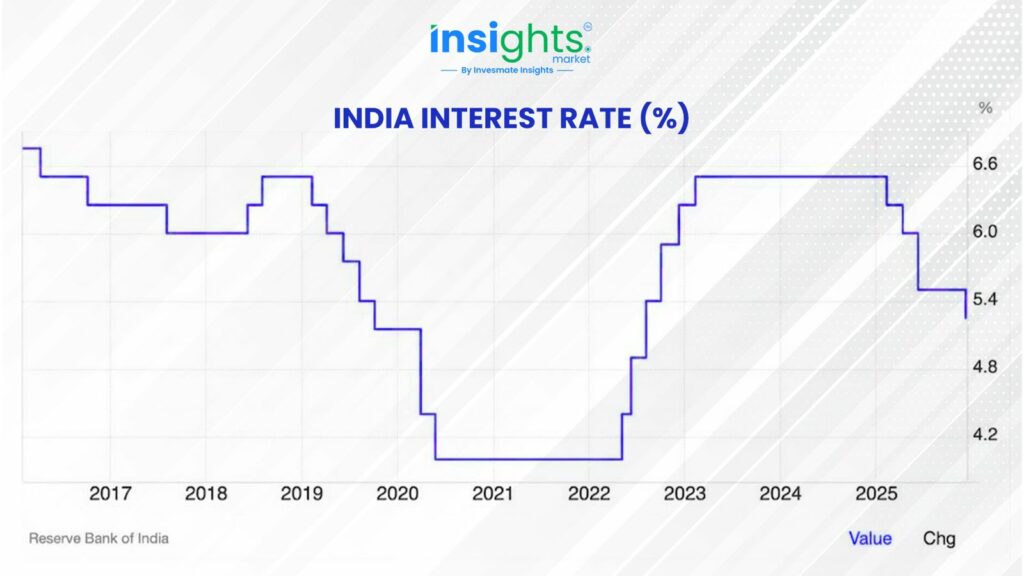
The Reserve Bank of India cut interest rates by about 125 basis points in 2025, bringing them down to around 5.25%.
In theory, lower interest rates should make stocks more appealing. However, something odd is happening: inflation decreased to about 0.25%, one of the lowest readings in years.
While low inflation sounds good, it’s actually a warning sign. Low inflation with slowing nominal growth means companies are making less in real terms.
Profit growth is slowing, even as the RBI cuts rates. If rate cuts aren’t pushing markets higher, it suggests valuations may already be stretched.
Read More: Gold vs Stocks in 2025: Which Investment Delivers Better Returns for Indians?
Five Real Reasons Why Nifty Is Falling
- Stretched valuations, especially in midcaps and smallcaps
- US trade uncertainty, global tariff risks, creating uncertainty
- Foreign investor selling, persistent FII outflows during 2025
- Weak earnings revisions, analysts cutting forecasts
- Geopolitical tensions, ongoing global conflicts affecting sentiment
The VIX: When Calmness Becomes Dangerous
The India VIX, or fear gauge, hovers near historic lows around 9 to 10. Normally this sounds positive, but it can also be a warning sign.
When investors stop worrying and become complacent, they stop protecting themselves. It’s like crossing a busy highway with your eyes closed—just because you can’t see danger doesn’t mean it isn’t there.

So Is the Indian Market in a Bubble? The Honest Answer
The Nifty 50 large-cap segment seems broadly fairly valued.
But midcaps and smallcaps remain expensive. More importantly, the market itself shows warning signs: promoters trimming their stakes, foreign investors lowering their exposure, retail investors buying aggressively, and IPO returns cooling.
This isn’t necessarily a classical “burst-tomorrow” bubble. But optimism has driven prices beyond what fundamentals justify, especially outside the large-cap core.
What Should You Do?
Focus on valuation discipline
– Be cautious with midcaps and smallcaps
– Avoid chasing IPO hype
– Prefer large-cap quality businesses
– Track promoter activity closely
The Indian economy remains strong with growth expectations intact. However, a strong economy doesn’t guarantee returns in the stock market. Right now, much of the good news is already priced in. Being patient and selective will likely work better than being aggressive.
Real wealth is built through discipline, not by riding bubbles.
Disclaimer: This content is for educational and knowledge-sharing purposes only and should not be construed as investment advice or a recommendation to buy or sell any securities.
FAQs
The Nifty 50 can sometimes give a misleading picture because it is driven by a few heavyweight stocks. When these large companies perform well, the index looks strong, even if many other stocks in the market are under pressure. This is why headline index levels may not always reflect broader market conditions.
The Nifty 50 includes India’s top 50 largest companies, while the Nifty Next 50 represents companies ranked from 51 to 100. Although both are large-cap indices, the Nifty Next 50 is usually less concentrated and more evenly spread across sectors, which can lead to different risk and return behaviour.
Midcap and smallcap stocks are more sensitive to changes in risk appetite. When valuations are high and global uncertainty increases, investors often book profits in these high-beta stocks first. As a result, broader markets may weaken even if benchmark indices remain stable.
Midcap and smallcap stocks are currently trading above their long-term average valuation levels. This does not automatically mean they are bad investments, but it does mean that prices have moved ahead of fundamentals, making them more vulnerable to corrections during uncertain phases.
Corrections often occur when prices rise faster than earnings. After a sharp rally, even small negative triggers or global concerns can lead to profit booking. This process helps markets cool down and return closer to more sustainable valuation levels.
This blog does not classify the current market phase as either a buying opportunity or a warning. It is intended only to explain market behaviour, valuation dynamics, and investor sentiment. Individual investment decisions depend on personal goals, risk tolerance, and time horizon.
The information provided in this reference is for educational purposes only and should not be considered investment advice or a recommendation. As an SEBI-registered organization, our objective is to provide general knowledge and understanding of investment concepts.
It is recommended that you conduct your own research and analysis before making any investment decisions. We believe that investment decisions should be based on personal conviction and not borrowed from external sources. Therefore, we do not assume any liability or responsibility for investment decisions made based on the information provided in this reference.