


Okay, so imagine you and your friend spend years planning this epic road trip together. You’ve signed the contract, packed your bags, sorted the playlist — and then right before you hit the road, your friend goes, “Oh wait, I also need to put up a toll gate on my side of the road.” That’s basically what’s happening with India and the UK right now. And the toll gate? It’s made of steel.
“The India-UK Free Trade Agreement was supposed to open doors. But Britain just quietly slammed one shut — and it’s labelled: Steel.”
— THE TRADE CONFLICT IN A NUTSHELL
First, the Good News
India and the UK signed a landmark Free Trade Agreement (FTA) in July 2025. The deal was a big deal — literally. It promised to lower tariffs on everything from Indian textiles and pharmaceuticals to British whisky and cars. The goal? Push bilateral trade from $57 billion to $120 billion by 2030 . Under it, 99% of Indian exports would enter the UK completely duty-free. Sounds great, right?
It was. Until steel walked in and ruined the party.
$57B
Current bilateral trade
$120B
Target by 2030
$893M
Indian steel at stake
60%
Quota cut by UK
So What Actually Happened?
In March 2026, the UK announced brand new steel safeguard measures — kicking in from July 1, 2026. Here’s what that means in plain English:
The amount of steel India can send to the UK tariff-free has been slashed by 60%
Anything above that limit gets hit with a whopping 50% tariff — double the old 25%
These measures weren’t part of FTA discussions at all — India found out after the deal was done
India’s Commerce Secretary Rajesh Agrawal basically said: “Hey, we’re close to making this deal happen, but this steel thing wasn’t in our script.” And now both sides are scrambling to find what they’re diplomatically calling a “creative solution.”

But Why Did the UK Do This?
To be fair to the UK — they didn’t just wake up and decide to ruin India’s day. There’s a deeper reason: China’s steel flood. China built massive steel capacity during its construction boom. Then the boom ended. The real estate market collapsed. But the steel mills? They kept running. China ended up exporting a record 119 million metric tonnes of steel globally in 2025 — at prices no one else could match, thanks to heavy government subsidies.
That cheap steel started flooding into global markets — the US, Europe, and yes, the UK. So the UK said: enough. They tightened their import restrictions. But here’s the kicker — under WTO rules, you can’t keep renewing temporary safeguard measures forever. The UK’s older protections were expiring, so they had to build a brand new framework from scratch. That new one turned out to be much stricter — and it landed right on top of the India FTA launch date. Wrong place, wrong time.
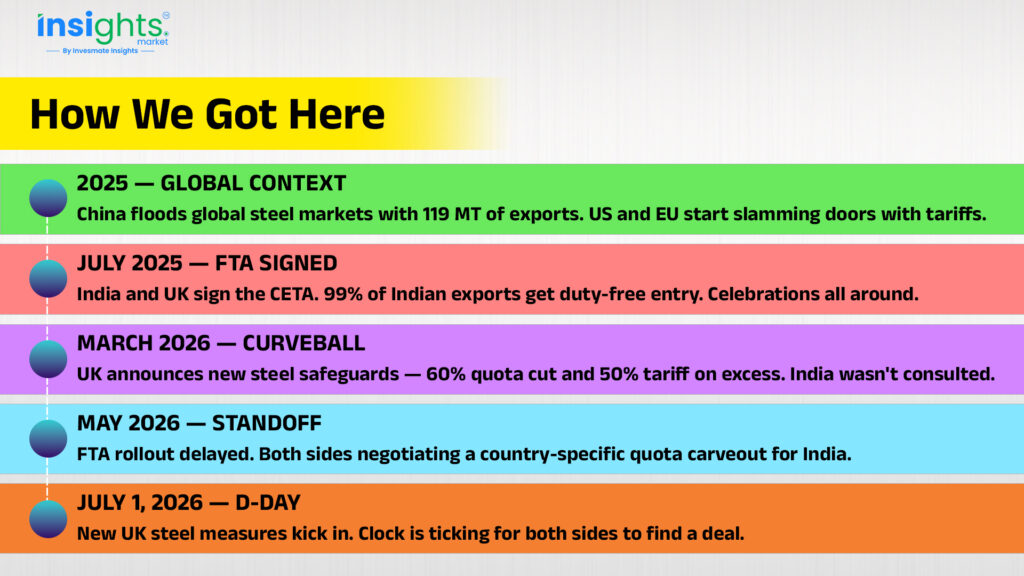
How We Got Here
What Does This Mean for Steel Stocks?
Here’s where it gets interesting for investors. The UK mess is actually only part of the story. Indian steel stocks are pulling in two directions right now:
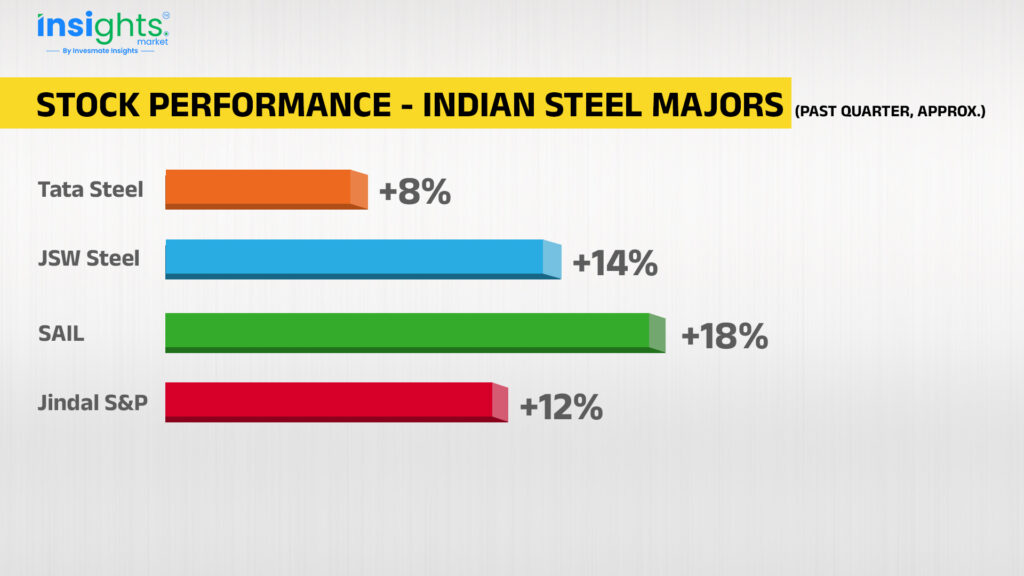
Wait — if UK is restricting India, why are stocks going up? Because domestically, India slapped its own 12% safeguard duty on imported steel (mainly Chinese), protecting local producers. Steel prices rose 18– 25% in India. That’s good for margins.
Here's the Irony Nobody's Talking About
India is fighting to keep its steel access in UK markets. But India itself is targeting 300 million tonnes of steel production per year by 2030 — up from 160 million tonnes today. So the same overcapacity problem India is complaining about from China? India might be creating it for others in just a few years. Trade is a funny game.
The Bottom Line
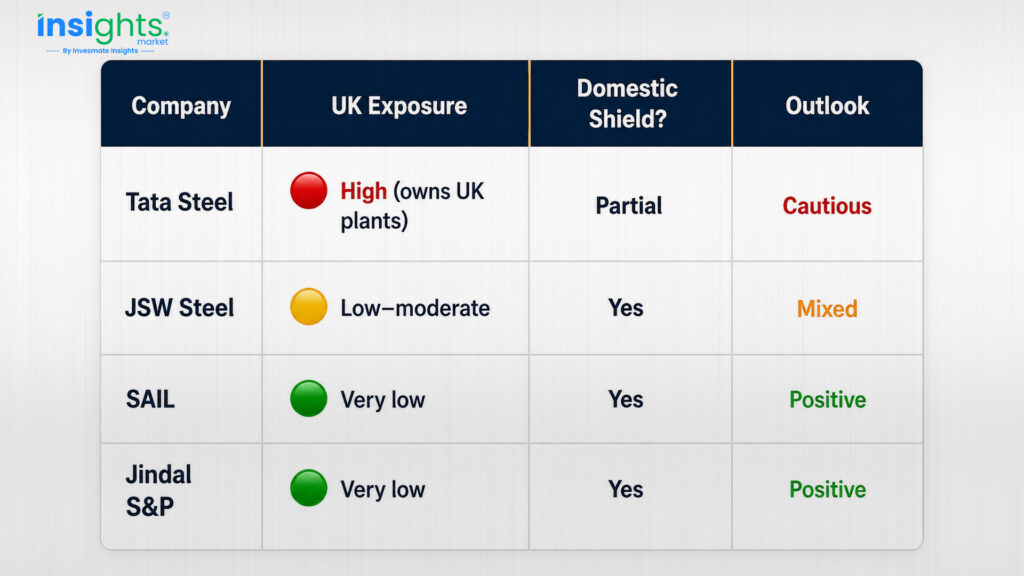
The India-UK FTA isn’t dead. Both countries want it to work — too much is riding on it. But steel has become an unexpected speed bump on the road to a $120 billion trade relationship. The most likely outcome is a country-specific quota for India baked into the UK’s new framework — essentially a workaround that lets both governments save face. For investors, the key takeaway is this: Tata Steel carries the most headline risk given its UK operations. SAIL and Jindal remain largely insulated.
And India’s domestic safeguard duty is actually a tailwind — for now. Watch for updates around the July 1 deadline and whether that “creative solution” materialises. Because in trade, as in cricket, you never know who’s going to drop the catch right before the finish line.
FAQs
The India–UK Free Trade Agreement (FTA) is a trade pact aimed at reducing tariffs and improving market access between both countries. The agreement targets increasing bilateral trade from $57 billion to $120 billion by 2030, with nearly 99% of Indian exports expected to receive duty-free access to the UK market.
Steel became a major issue after the UK introduced new safeguard measures that cut India’s tariff-free steel quota by 60% and imposed a 50% tariff on shipments beyond the limit. Since these measures were announced after FTA discussions, they created unexpected friction between both countries.
The UK tightened steel imports mainly because of global oversupply caused by China. Chinese steel exports surged due to excess production and government support, flooding international markets with cheaper steel and prompting countries like the UK to strengthen protection for domestic industries.
The impact differs across companies. Tata Steel may face greater headline risk due to its UK exposure, while companies such as SAIL and Jindal Steel remain relatively insulated because their businesses depend more on domestic demand and other markets.
Indian steel stocks have gained support because India imposed a 12% safeguard duty on imported steel, particularly low-cost imports. This has improved domestic steel prices and strengthened profit margins for local steel manufacturers.
The most likely outcome is a country-specific quota arrangement for India within the UK’s new steel framework. Such a compromise could preserve India’s export access while allowing the UK to maintain its domestic steel protection measures.
This article is for educational and informational purposes only. It is not investment advice or a stock recommendation. Investors should conduct their own research or consult a qualified financial advisor before making investment decisions.