

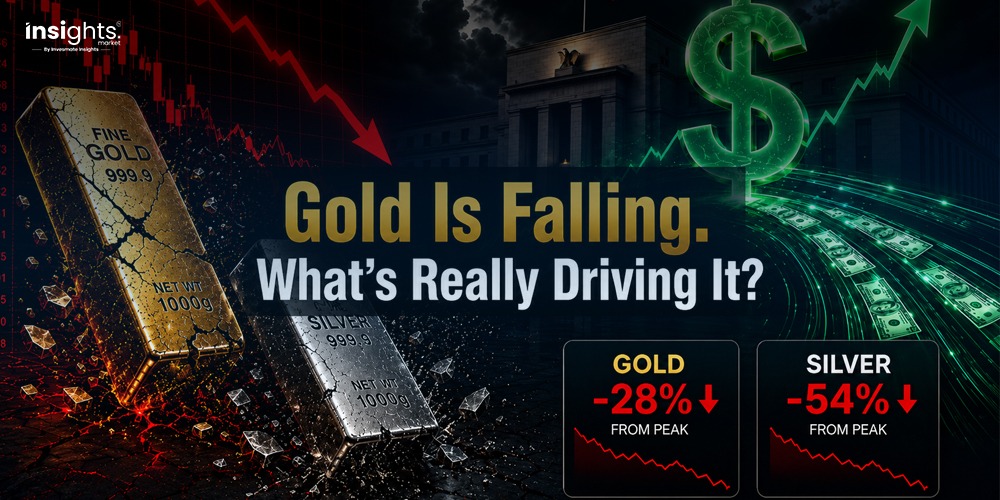

Gold has long been considered one of the safest investments during uncertain times. But this time, even geopolitical tensions and global uncertainty couldn’t stop a sharp fall in precious metals. Gold has dropped to its lowest level in nearly seven months, while silver has corrected even more sharply, leaving many investors wondering whether this is the end of the rally or simply a buying opportunity.
In this article, we’ll explain why gold and silver prices are falling, what role the US Federal Reserve and the US dollar are playing, how the correction could affect Indian investors, and what investors should consider doing next.
Gold & Silver Have Corrected Sharply
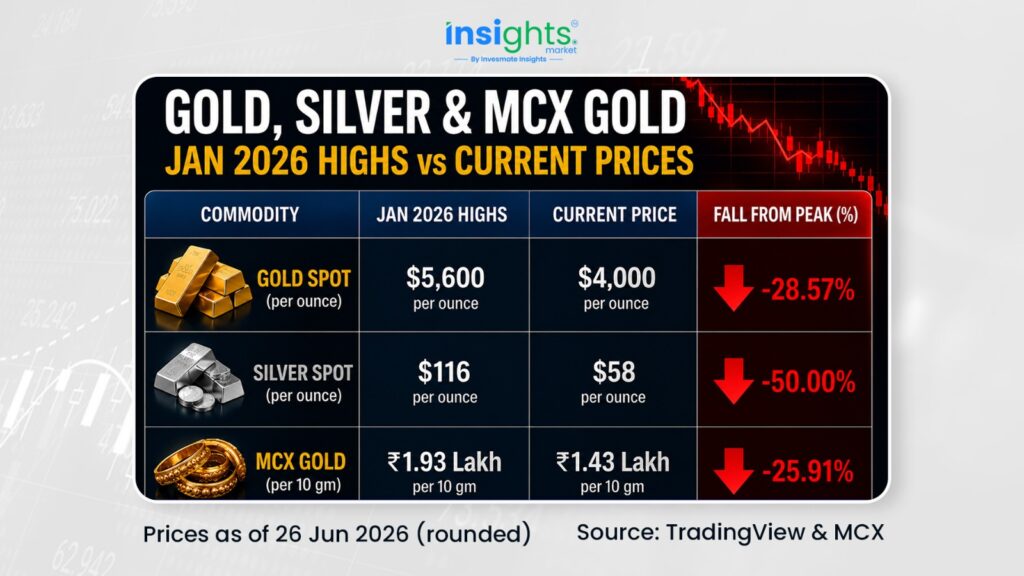
After reaching record highs in January 2026, precious metals have witnessed one of their biggest corrections in recent years.
International gold prices have fallen below $4,000 per ounce, down significantly from their January peak of around $5,595. In the domestic market, MCX Gold has corrected by more than 26%, falling from nearly ₹1.93 lakh per 10 grams to around ₹1.42 lakh per 10 grams. Silver has witnessed an even steeper decline, trading near $56–58 per ounce, which is less than half of its January record high. While such corrections may look alarming, understanding the reasons behind them is more important than reacting emotionally.
Why Are Gold & Silver Falling?
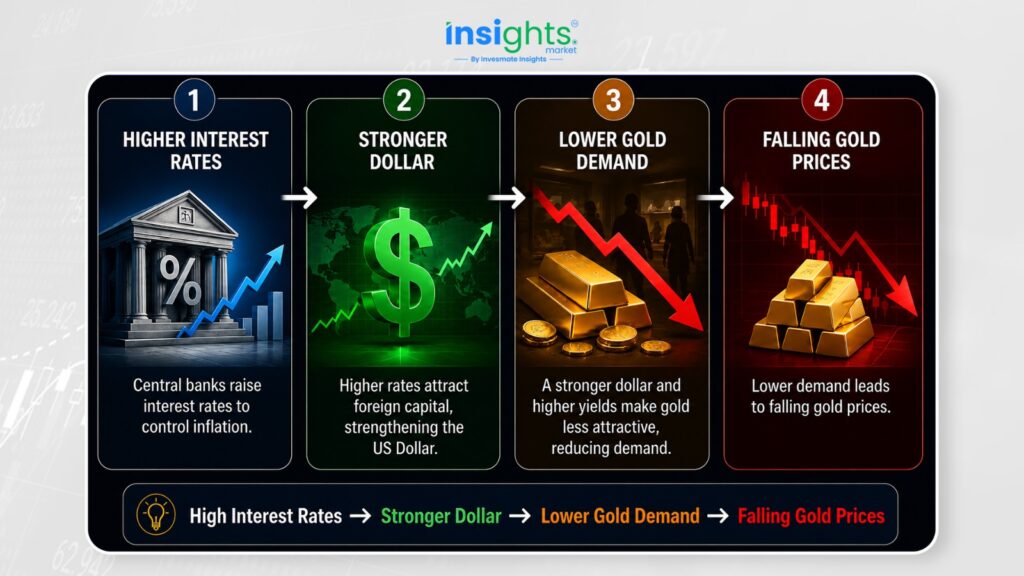
The biggest reason behind the correction is not the weak demand for gold itself. Instead, it is the rapid change in global monetary policy expectations.
Markets now expect the US Federal Reserve to keep interest rates higher for longer, and some policymakers have even indicated that another rate hike is possible before the end of the year. Higher interest rates increase the returns available on bonds and other fixed-income investments.
Unlike bonds or fixed deposits, gold does not generate regular income. As a result, many investors prefer shifting their money into interest-bearing assets when rates remain high, reducing demand for bullion.
A Stronger US Dollar Is Adding More Pressure
Another major factor is the strength of the US dollar. Since gold is priced globally in US dollars, a stronger dollar makes it more expensive for buyers using other currencies. This often reduces international demand and puts additional pressure on prices. The Dollar Index has climbed to its highest level in more than a year, adding to the weakness in precious metals.
Money Is Moving From Gold To AI And Equities
Investor preferences have also changed dramatically over the past few months. As artificial intelligence continues to dominate global markets, many investors are moving money out of Gold ETFs and into technology and AI-related companies in search of higher returns.
This shift has resulted in noticeable outflows from gold-backed exchange-traded funds while equity markets continue to attract fresh capital. This rotation doesn’t necessarily mean gold has lost its importance. It simply shows that investors are currently favouring growth assets over traditional safe havens.

Why Is Silver Falling More Than Gold?
Although gold and silver are often grouped, they behave differently during economic slowdowns. Gold is primarily a safe-haven asset, while silver also has significant industrial uses in sectors such as electronics, solar panels, and manufacturing.
When investors become worried about slower economic growth, expectations for industrial demand also weaken, making silver more volatile than gold. That explains why silver has corrected much more sharply during the recent sell-off.
What Does This Mean For Indian Investors?
The decline in bullion prices has broader implications across multiple segments of the Indian economy. Industries such as gold financing, jewellery retail, and precious metal refining may experience short-term pressure due to lower asset values and reduced investor sentiment. At the same time, sectors dependent on gold imports could benefit from lower input costs, potentially improving margins.
For the financial sector, especially institutions involved in gold-backed lending, the impact is typically limited due to conservative loan-to-value ratios. However, market sentiment and investor perception can still influence valuations.
Overall, the correction reflects a cyclical shift rather than a structural weakness, with varying effects across industries linked to precious metals.
Will Gold Recover?
The long-term investment case for gold has not completely changed. Gold continues to serve as a hedge against inflation, currency depreciation, and unexpected geopolitical events.
However, in the near term, its direction will largely depend on three global factors:
- US Federal Reserve interest-rate decisions
- Movement in the US Dollar Index
- Inflation data from the United States
If the Federal Reserve signals the end of its tightening cycle or the dollar begins to weaken, gold could regain strength. Until then, volatility is likely to remain high.
Should Investors Buy The Dip?
Trying to predict the exact bottom is almost impossible. Instead of making large lump-sum investments after a sharp correction, investors may consider gradually accumulating gold over time.
A staggered investment approach can help reduce the impact of short-term volatility while maintaining exposure to an asset that has historically played an important role in diversified portfolios.
For investors with a long-term horizon, this correction may present an opportunity to accumulate quality exposure rather than panic.
Final Takeaway
The recent correction in gold and silver is being driven more by global monetary policy than by a collapse in their long-term fundamentals. Higher US interest-rate expectations, a stronger dollar, and the ongoing shift of capital toward AI and technology stocks have reduced the appeal of precious metals in the short term.
For investors, patience may be the best strategy. Gold remains an important portfolio diversifier and inflation hedge, but its near-term performance will largely depend on future Federal Reserve decisions and the direction of the US dollar. Rather than chasing prices or reacting to headlines, investors should focus on gradual accumulation and maintain a well-diversified portfolio.
FAQs
Gold and silver are under pressure due to a stronger US dollar, expectations of higher US interest rates, rising bond yields, and reduced demand for safe-haven assets.
Gold is priced in US dollars. When the dollar strengthens, gold becomes more expensive for international buyers, reducing demand and putting pressure on prices.
Gold does not earn interest or dividends. When interest rates rise, investors often shift toward bonds and other fixed-income assets that offer higher returns.
Unlike gold, silver is widely used in industries such as electronics, solar energy, and manufacturing. Concerns about slower economic growth can reduce industrial demand, making silver more volatile.
For long-term investors, a sharp correction may offer an opportunity to accumulate gradually. However, investing in phases rather than all at once can help manage short-term volatility.
Gold could recover if the US Federal Reserve slows or stops raising interest rates, the US dollar weakens, or global economic uncertainty increases again.
Selling in panic after a sharp correction is generally not advisable. Investors should review their financial goals and asset allocation before making any investment decision.
Yes. Despite short-term volatility, gold continues to play an important role as a portfolio diversifier and a hedge against inflation, currency depreciation, and geopolitical uncertainty.
This article is for educational and informational purposes only. It is not investment advice or a stock recommendation. Investors should conduct their own research or consult a qualified financial advisor before making investment decisions.