


India’s stock market has witnessed one of its biggest structural reforms in recent years with the introduction of the Closing Auction Session (CAS). Effective from 3 August 2026, SEBI has changed the way closing prices are determined for Futures & Options (F&O) stocks. Instead of using the last 30-minute Volume Weighted Average Price (VWAP), exchanges now determine a single equilibrium price where the maximum number of buy and sell orders can be matched.
The objective is simple: to make closing prices more transparent, reduce the scope for manipulation, and align Indian markets with global exchanges such as the NYSE, NASDAQ, and London Stock Exchange. In this article, we’ll explain why SEBI introduced CAS, how it works, what has changed for traders, its benefits and risks, and what the first few trading sessions reveal.
Why Did SEBI Replace the Old Closing Price System?
Earlier, the official closing price of F&O stocks was calculated using the VWAP of trades between 3:00 PM and 3:30 PM. Although this method was more reliable than using the last traded price, it still allowed large institutional orders during the final few minutes to influence the closing price. Since the closing price is used for Mutual Fund NAVs, ETF tracking, benchmark indices, portfolio valuation, pledged shares, and F&O settlement, any distortion could affect the broader market. To address this, SEBI introduced the Closing Auction Session (CAS), where all eligible buy and sell orders are matched at a single equilibrium price, making closing prices more transparent and reducing the scope for end-of-day price manipulation.
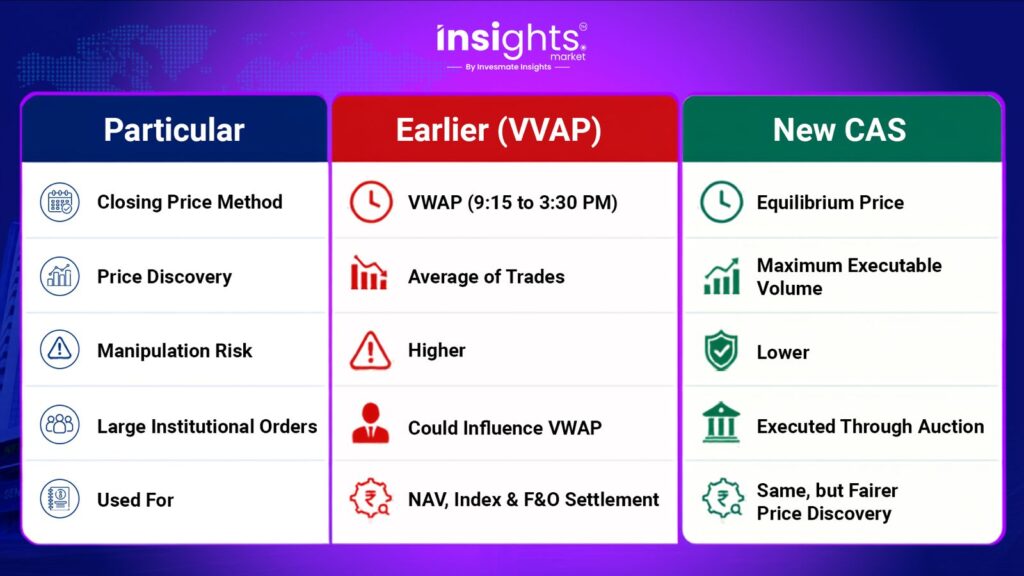
What Has Changed Under the New Closing Auction Session?
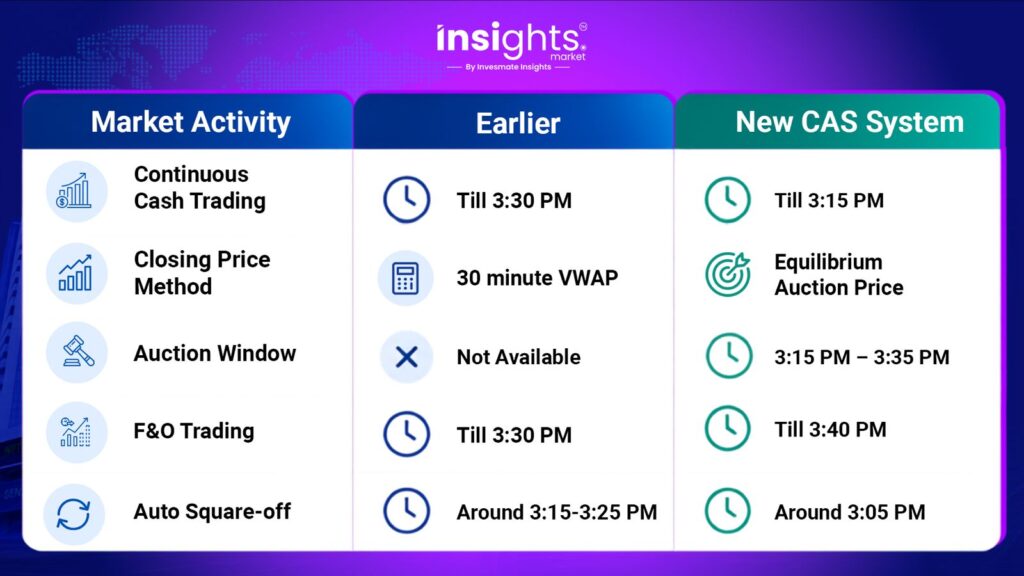
The introduction of CAS has changed the last 30 minutes of trading for F&O stocks. The most noticeable change is that continuous cash-market trading for F&O stocks now stops at 3:15 PM, instead of continuing until 3:30 PM. After that, the exchange conducts a structured auction to determine the official closing price. Meanwhile, F&O derivatives continue trading until 3:40 PM, giving traders extra time to adjust their positions after the cash market closes. Brokers have also moved intraday auto-square-offs to around 3:05 PM so that positions are closed before the auction begins.
How Does the Closing Auction Session Work?
The CAS follows a structured five-stage process.
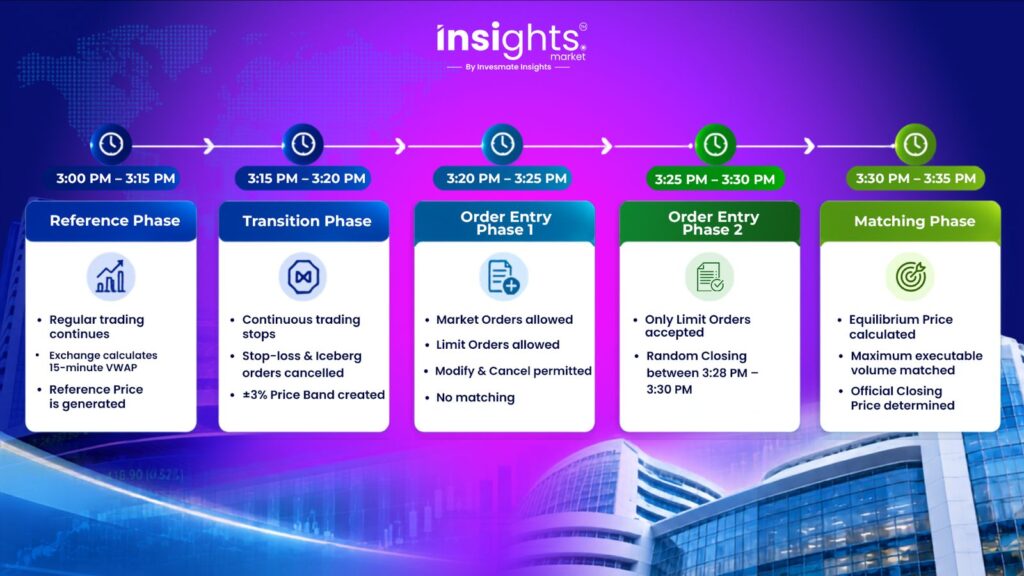
The exchange matches all eligible buy and sell orders at the equilibrium price, the price where the maximum tradable volume can be executed. This becomes the official closing price.
Why Is the New CAS Better?
The Closing Auction Session offers several long-term benefits for market participants by improving the quality of closing price discovery.
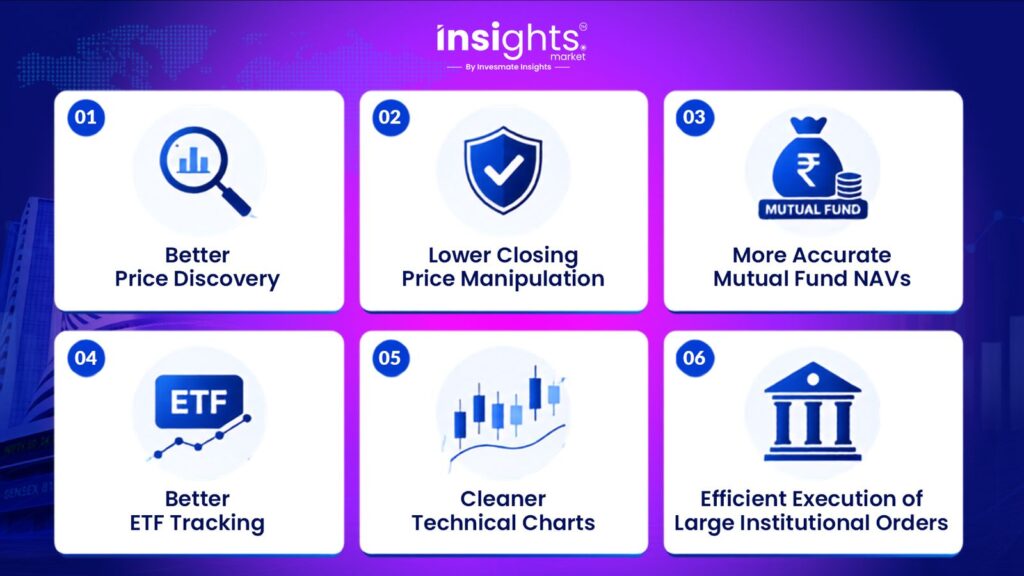
These improvements are expected to make India’s closing price mechanism more transparent and globally aligned.
What Are the Risks and Challenges?
Like any major market reform, CAS comes with an adjustment period.
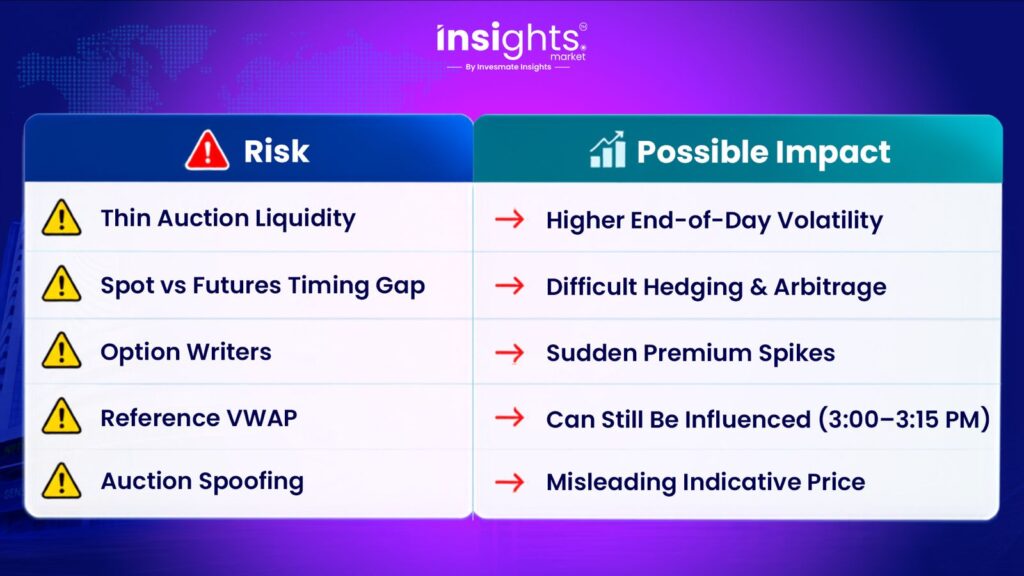
Although these challenges have been visible during the initial rollout, they are expected to reduce as participation in the auction increases and liquidity improves.
How Did the Market React to SEBI's New Closing Auction Rule?
The Closing Auction Session is already influencing end-of-day market behaviour. The first few trading sessions after implementation provide an early glimpse of how traders are adapting to the new mechanism.
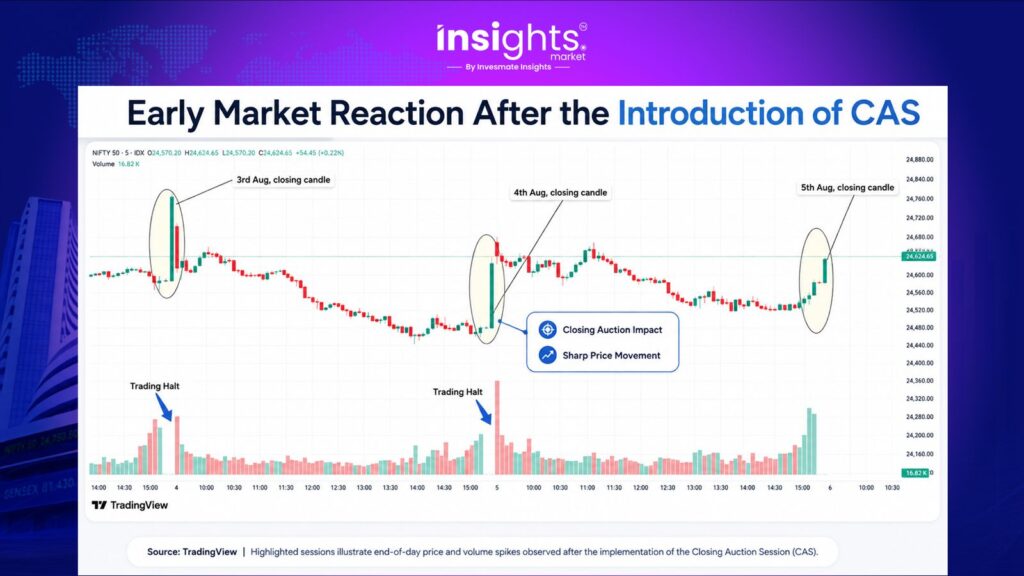
As shown in the chart below, the Nifty 50 witnessed sharp end-of-day price movements on August 3, 4, and 5, accompanied by a significant increase in trading volume. The strong closing candles indicate that institutional activity has shifted towards the auction window, making the final few minutes of trading more important than before. Unlike the earlier VWAP system, the new CAS concentrates liquidity into a short auction window. As participation improves, these sharp moves are expected to moderate, resulting in a more efficient and transparent closing price discovery process.
What Does This Mean for Retail Investors?
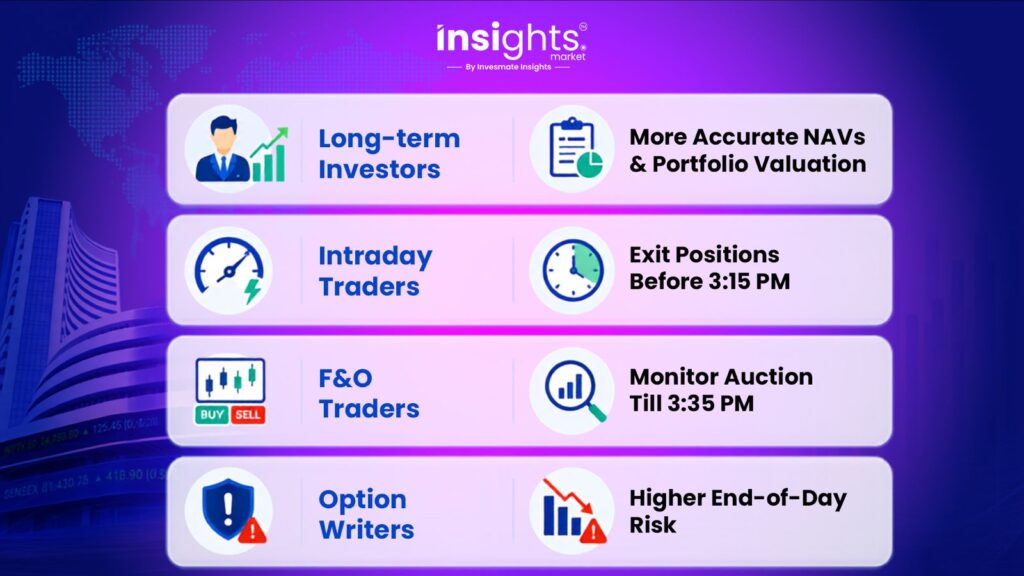
For long-term investors, CAS is expected to improve price transparency. Active traders, however, should adapt to the revised trading schedule and understand how the auction influences settlement prices and end-of-day volatility.
Conclusion
The Closing Auction Session marks a significant shift in India’s market structure. By replacing the traditional VWAP method with an equilibrium-based auction, SEBI aims to create a fairer, more transparent, and globally aligned closing price mechanism.
While the market may witness higher end-of-day volatility during the initial adjustment period, the long-term objective remains clear—improve price discovery, reduce manipulation, and strengthen investor confidence. As auction participation grows, CAS is expected to become an integral part of India’s equity market, making it an important concept for every investor and trader to understand.
FAQs
The Closing Auction Session (CAS) is a new mechanism introduced by SEBI to determine the official closing price of F&O stocks using an equilibrium price instead of the earlier 30-minute VWAP method.
SEBI introduced CAS to improve price discovery, reduce end-of-day price manipulation, and make India’s closing price mechanism more transparent and aligned with global markets.
Continuous cash trading for F&O stocks now ends at 3:15 PM, the Closing Auction Session runs until 3:35 PM, and F&O derivative trading continues until 3:40 PM.
The closing price is determined using the equilibrium price, where the maximum number of buy and sell orders can be matched during the auction session.
The new mechanism currently applies to Phase 1 F&O stocks listed on the exchanges.
For long-term investors, CAS provides more transparent closing prices, improving Mutual Fund NAVs, ETF tracking, and portfolio valuation. Active traders should adapt to the revised market timings.
The initial implementation has resulted in higher end-of-day volatility due to lower auction participation. However, volatility is expected to moderate as liquidity and participation improve.
Since cash trading ends at 3:15 PM while derivatives continue until 3:40 PM, F&O traders need to closely monitor the auction period, as it can significantly influence settlement prices and option premiums.
This article is for educational and informational purposes only. It is not investment advice or a stock recommendation. Investors should conduct their own research or consult a qualified financial advisor before making investment decisions.