

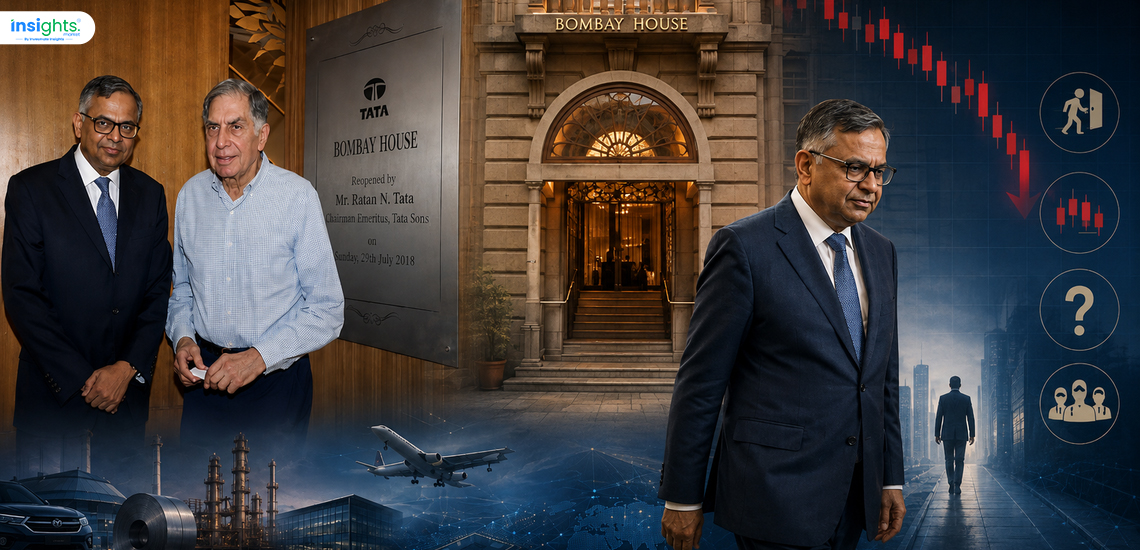

The Tata Group has come under the market spotlight after N Chandrasekaran announced that he will not seek another term as Tata Sons chairman after his current tenure ends on February 20, 2027. The announcement triggered an immediate reaction across Tata Group stocks as investors began assessing what the leadership transition could mean for the group’s future strategy, capital allocation, and large ongoing investments. In this article, we will discuss the reasons behind the market reaction and its possible implications.
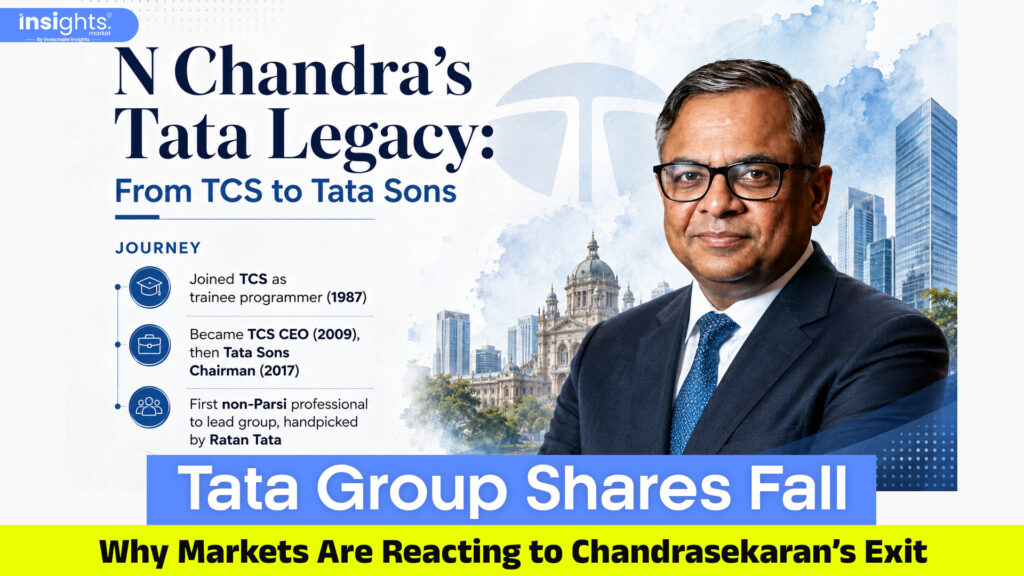
What Does Chandrasekaran’s Exit Mean?
Chandrasekaran has clarified that this is a planned leadership transition rather than an abrupt exit. He will continue as Chairman until February 2027 and has indicated that the Group will remain focused on execution, stability, and strengthening newer businesses such as digital, semiconductors and clean energy. The announcement is important because Chandrasekaran has been at the centre of the Tata Group since 2017, overseeing major strategic moves including Air India, Tata Digital, electric mobility, semiconductors, batteries and electronics.
Tata Sons' Leadership Through the Years
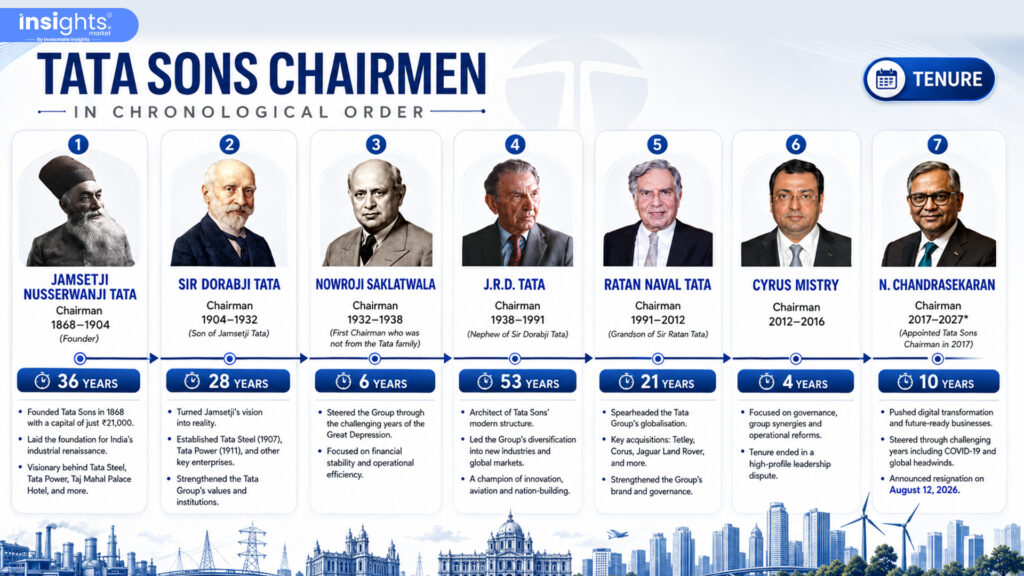
Tata Sons has been led by seven chairmen since its foundation. From Jamsetji Tata and J.R.D. Tata to Ratan Tata, Cyrus Mistry and N. Chandrasekaran, each leadership period has shaped a different phase of the Group’s development.
Why Are Tata Group Shares Falling?
The immediate market reaction is mainly about uncertainty over succession and future strategy, rather than an immediate deterioration in Tata Group fundamentals. The concern was clearly visible in TCS, where shares fell around 4%, wiping out nearly ₹35,000 crore of market value in a single session. The broader weakness across Tata stocks reflects investor uncertainty over whether the next Chairman will maintain Chandrasekaran’s investment priorities and capital allocation strategy.
Chandrasekaran’s Tata Legacy
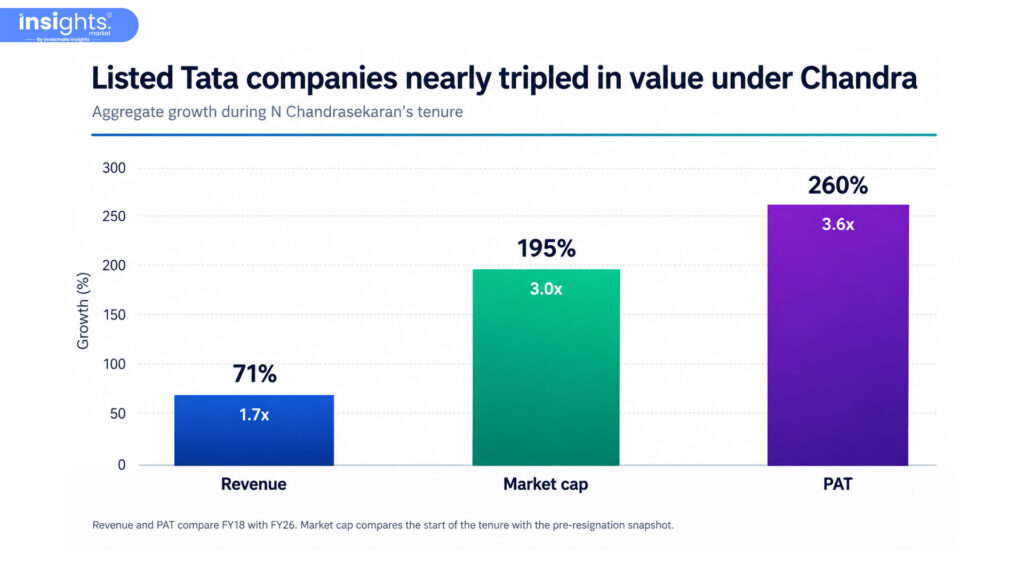
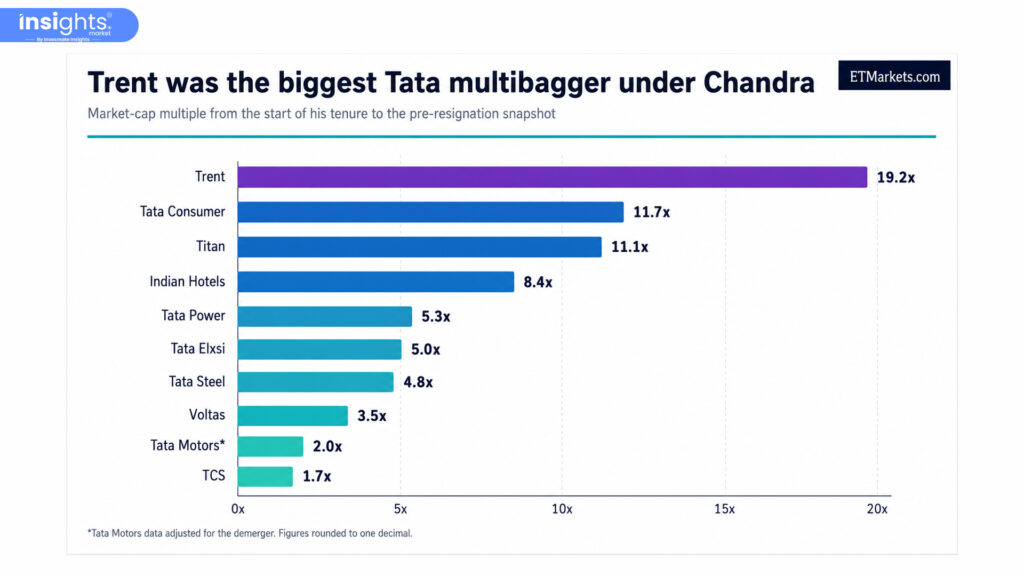
Despite the current market reaction, Chandrasekaran leaves behind a strong financial record. According to a report from SBI Securities, the combined market capitalization of listed Tata companies increased from ₹8.53 lakh crore in FY18 to ₹25.21 lakh crore, creating around ₹16.67 lakh crore in additional market value. During the same period, aggregate revenue increased from ₹6.48 lakh crore to ₹11.10 lakh crore, while combined PAT rose from ₹45,326 crore to ₹1.63 lakh crore.
The performance, however, was not equal across all Tata companies. Titan, TCS, Tata Steel, and Trent contributed around two-thirds of the total market-cap increase during the period. Titan added nearly ₹4.10 lakh crore in market value, while TCS contributed around ₹3.60 lakh crore. Trent was the standout multibagger, with its market capitalization rising 19.2 times to ₹1.59 lakh crore.
What Investors Should Watch Next
The leadership transition comes as several Tata businesses require significant capital and execution. Air India reported a ₹22,238 crore loss in FY26, while Tata Digital reported an estimated ₹5,000 crore loss, highlighting the need for a clear path to profitability. Tata Electronics and semiconductor projects remain in development and scaling phases, while the potential Tata Sons listing and future capital allocation strategy remain important areas to monitor. Over the next 2–3 years, investors should focus on succession clarity, capital allocation discipline, the Air India turnaround, Tata Digital’s profitability, semiconductor execution, and global demand cycles affecting Tata’s IT and steel businesses.
Conclusion
The recent fall in Tata Group stocks appears to reflect leadership-transition uncertainty rather than an immediate weakness in core fundamentals. Chandrasekaran will remain Chairman until February 2027, giving Tata Sons time for a smooth transition. The key question now is whether the next leadership team can maintain the Group’s growth momentum, execute its capital-intensive projects, and continue the value-creation journey built under Chandrasekaran.
FAQs
The recent decline is mainly due to uncertainty around leadership succession and the Group’s future strategy after N. Chandrasekaran announced that he will not seek another term as Tata Sons Chairman after February 20, 2027.
Chandrasekaran is expected to remain Chairman until the end of his current tenure on February 20, 2027.
TCS shares fell around 4%, resulting in nearly ₹35,000 crore of market-value erosion in a single session.
The market is watching whether the next Chairman will maintain the current focus on capital allocation, digital businesses, semiconductors, clean energy, Air India and other strategic investments.
The combined market capitalization of listed Tata companies increased from ₹8.53 lakh crore in FY18 to ₹25.21 lakh crore, while aggregate revenue rose from ₹6.48 lakh crore to ₹11.10 lakh crore and combined PAT increased from ₹45,326 crore to ₹1.63 lakh crore.
Key areas to watch include Air India’s losses, Tata Digital’s profitability, semiconductor and Tata Electronics execution, capital allocation, and the potential Tata Sons listing. Air India reported a ₹22,238 crore FY26 loss, while Tata Digital reported an estimated ₹5,000 crore FY26 loss.
The current market reaction appears to reflect leadership-transition uncertainty rather than an immediate deterioration in the Group’s core fundamentals. Investors should focus on the succession process, capital allocation, and execution across individual Tata companies.
Investors should monitor succession clarity, capital allocation discipline, the Air India turnaround, Tata Digital’s profitability, semiconductor execution and global demand cycles affecting Tata’s IT and steel businesses.
This article is for educational and informational purposes only. It is not investment advice or a stock recommendation. Investors should conduct their own research or consult a qualified financial advisor before making investment decisions.