



If you were an Indian retail investor between 2023 and 2025, chances are you had at least one railway or defence stock in your portfolio. For a while, these stocks seemed almost unstoppable. Names such as RVNL, IRFC, IRCTC, RITES, IRCON, HAL, BEL, Bharat Dynamics, Mazagon Dock, Cochin Shipyard and GRSE delivered spectacular returns as investors rushed into the government-capex and defence-indigenisation themes.
But the mood has changed. Several stocks have corrected sharply from their highs.
So, is this just a correction—or has the PSU growth story lost momentum?
The answer lies in earnings growth, order execution, and valuations, not just the PSU tag.

From Undervalued to Overcrowded: The PSU Journey
The PSU rally was not built entirely on speculation. It was supported by several genuine structural changes in the Indian economy.
- Government Capex: Railway capital expenditure had reached around ₹2.5 lakh crore annually, while overall government capex crossed approximately ₹11 lakh crore in FY26. The FY27 Budget continued the infrastructure push, with public capital expenditure of around ₹12.2 lakh crore and railway capex of nearly ₹2.93 lakh crore.
- Defence Indigenisation: The Aatmanirbhar Bharat initiative increased domestic defence procurement and reduced dependence on imports. Companies such as HAL, BEL and Bharat Dynamics benefited from stronger order flows.
- Valuation Re-rating: Many PSUs were historically ignored and traded at low valuations. As investors began recognising their improving businesses and stronger order books, valuations expanded rapidly. The problem was that, in several cases, share prices eventually rose much faster than earnings.
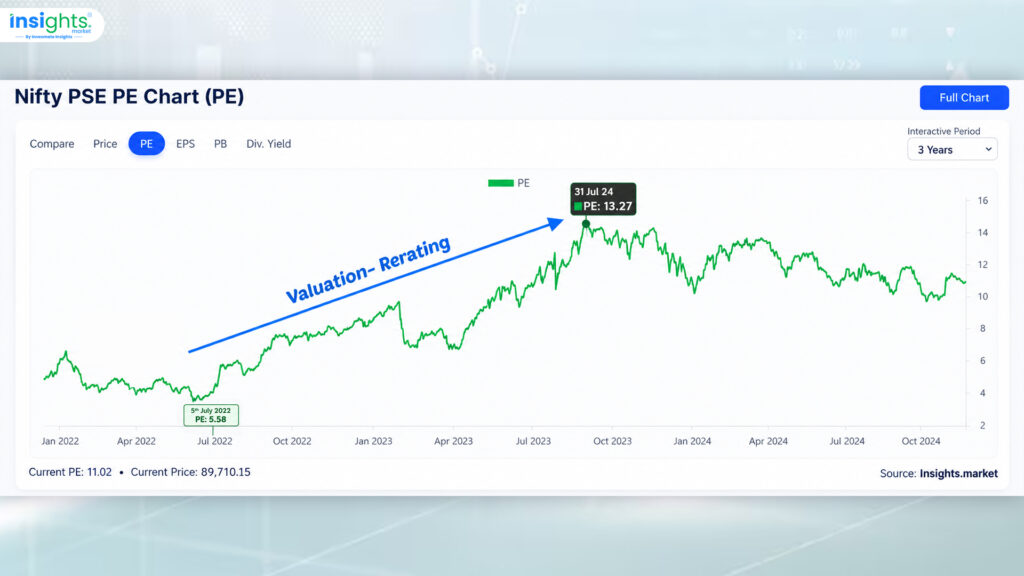
Why Did PSU Railway & Defence Stocks Fall?
- Valuations Became Expensive: This was arguably the biggest trigger. After delivering multibagger returns, several railway and defence stocks were valued at levels that left little room for disappointment. Once valuations become stretched, even good results may not be enough to push share prices higher. Investors increasingly started demanding actual earnings growth rather than simply buying the PSU theme.
- Budget Expectations Were Reset: The Union Budget 2025-26 disappointed investors looking for another major railway spending boost. Railway capex remained around ₹2.52 lakh crore, without a major new announcement for the sector. The issue was not that railway spending disappeared. Rather, market expectations had become much higher than the incremental improvement in spending.
- FII Selling and Risk-Off Sentiment: Foreign investor selling and broader risk aversion added pressure. Stocks that had already experienced significant re-ratings became particularly vulnerable when institutional investors started reducing exposure.
- Earnings Could Not Always Match Expectations: After the rally, weak quarterly results, slower execution, or margin pressure started receiving much stronger punishment. The market moved from asking “How big can the opportunity become?” to “How quickly will that opportunity become earnings?”
- Government Stake Sales: Government stake sales also created additional supply. The IRFC OFS in February 2026, for instance, came when railway stocks were already under pressure. While such transactions do not necessarily change business fundamentals, they can increase short-term volatility.
Railway Stocks: Correction or Structural Problem?
The railway sector shows why investors must separate business fundamentals from stock-price performance. Indian Railways continues to receive strong government support, with FY27 railway capex of around ₹2.93 lakh crore. Yet railway stocks have struggled because strong sector growth does not automatically justify every stock’s current valuation.
RVNL became a major multibagger during the railway boom but subsequently experienced a sharp correction. Its price has remained sensitive to government announcements, order wins and sector sentiment. Merger discussions with IRCON in 2026 further highlighted the stock’s headline sensitivity. IRFC has a fundamentally different business model, focused on financing railway assets. It reported its highest-ever FY26 profit of approximately ₹7,009 crore, up around 7.8% YoY. Yet the stock has cooled significantly from its earlier peak, showing that strong profitability alone cannot support an expensive valuation indefinitely. IRCTC and RailTel were also affected by the broader railway stock de-rating despite having very different businesses. This demonstrates how theme-based selling can impact stocks even when individual fundamentals remain relatively distinct.
Defence Stocks: The Story Is Strong, But Valuation Matters
The defence sector continues to have strong structural support. The government reported that 16 Defence PSUs recorded a combined FY26 turnover of around ₹1.29 lakh crore, up 15.4% YoY, while PAT increased 15.6% to ₹23,136 crore. Defence exports also rose sharply.
HAL remains a key beneficiary, with an order book of around ₹2.5 lakh crore, supported by aircraft and helicopter programmes. BEL continues to benefit from demand for defence electronics, radar and electronic warfare systems, while also building its export opportunity. Meanwhile, Bharat Dynamics, Mazagon Dock, Cochin Shipyard and GRSE experienced some of the sharpest corrections after extraordinary rallies. Yet the underlying order opportunity remains significant. Mazagon Dock, for example, had an FY26 order book of approximately ₹20,535 crore.
This highlights an important distinction: a falling share price does not automatically mean the business is deteriorating.
What Should Investors Watch Now?
Before deciding what to do next, investors should look beyond the broader PSU theme and focus on the factors that can determine whether individual stocks can sustain their growth
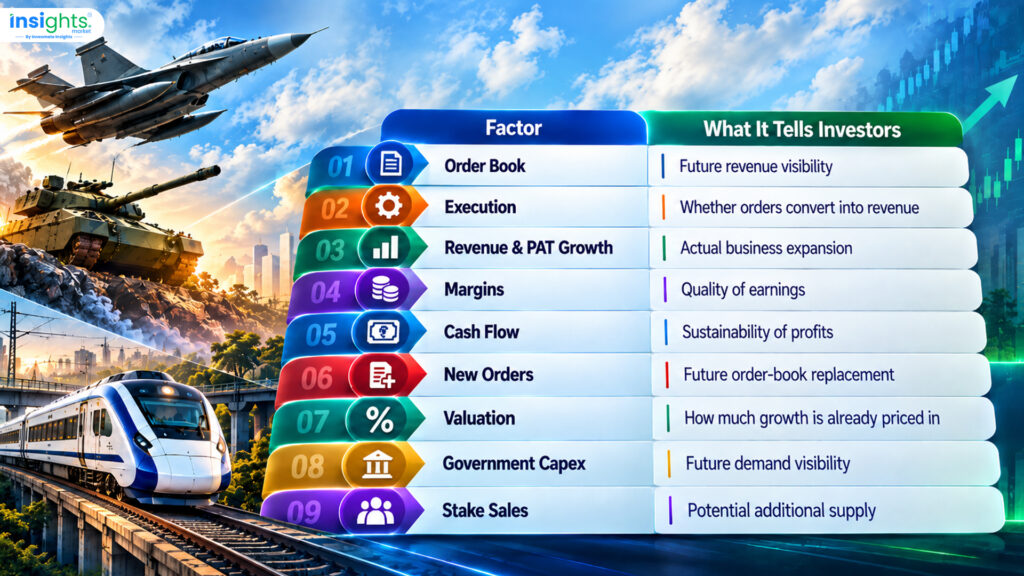
What Now for PSU Railway & Defence Investors?
The PSU railway and defence space is entering a different phase.
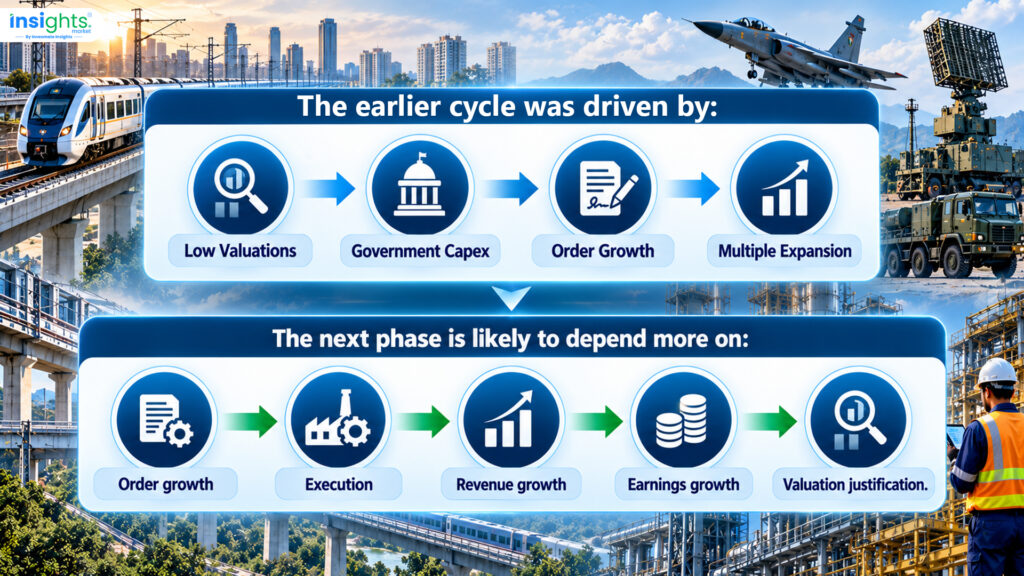
That means investors should no longer treat railway, defence, shipbuilding and PSU financial companies as one single trade.
Bottom Line
The PSU Railway and Defence story has not broken, but the easy re-rating phase is over. Going forward, earnings growth, order execution, margins, cash flow and valuation will drive returns. The focus is shifting from broad theme-based investing to selective stock picking, making company-specific fundamentals more important than the PSU tag.
FAQs
The correction is largely linked to high valuations, profit booking, slower-than-expected earnings growth, and changing investor expectations.
Yes, the broader story remains supported by high railway capex and infrastructure spending. However, individual stocks need to be evaluated based on valuation and earnings potential.
Many defence stocks had already been heavily re-rated. As valuations became expensive, the market started demanding stronger earnings growth and order execution.
Investors should focus on order book, execution, revenue growth, margins, cash flow, new orders and valuation rather than only the PSU status.
No. Railway, defence, shipbuilding and PSU financial companies have different business models, growth prospects and valuations. Stock selection has therefore become more important.
Some individual companies may deliver strong returns if earnings grow substantially, but another broad-based re-rating cannot be assumed.
The key risks include high valuations, execution delays, slower order growth, margin pressure, government stake sales and weaker-than-expected earnings.
The current market environment increasingly favours stock selection based on fundamentals, earnings growth and valuation rather than simply investing based on the broader PSU theme.
This article is for educational and informational purposes only. It is not investment advice or a stock recommendation. Investors should conduct their own research or consult a qualified financial advisor before making investment decisions.