


On September 23, 2026, India’s insurance regulator released one of the sector’s most consequential proposals in years — and the market reacted immediately. Shares of PB Fintech (Policybazaar) crashed as much as 33% and hit a 20% lower circuit at ₹1,508.90, while Turtlemint Fintech Solutions was locked 20% lower at ₹109.04. Life insurance heavyweights, including HDFC Life, SBI Life, ICICI Prudential Life, LIC, and Max Financial Services, were all in focus too, as investors scrambled to work out what IRDAI’s new “Recalibrating Economics of Insurance Distribution” consultation paper actually means for their businesses. Here’s a full breakdown of what’s being proposed, why IRDAI is doing this now, and how it changes the game for banks, NBFCs, insurers, brokers, and digital platforms.
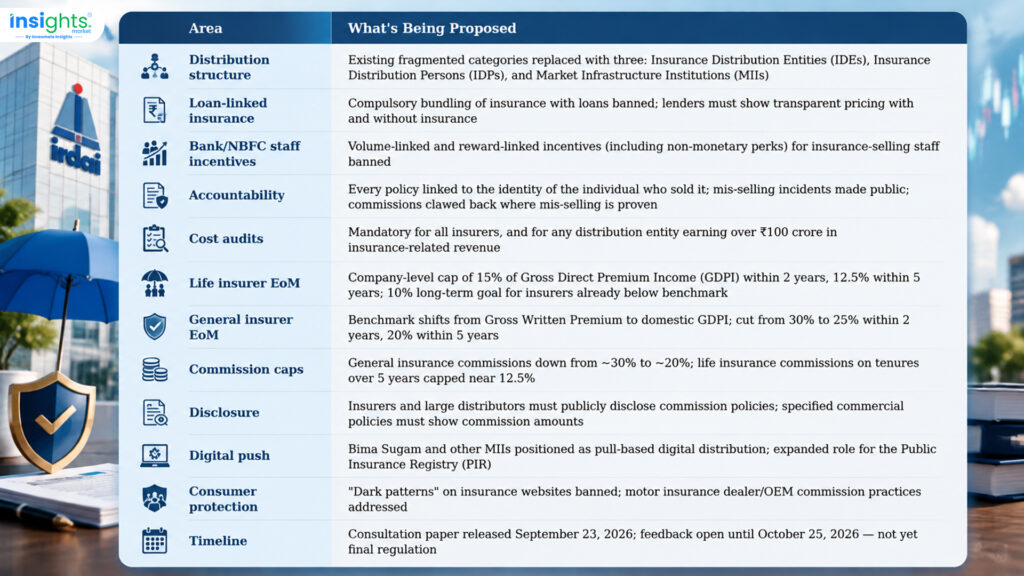
Key Proposals at a Glance
Why Now? The Problem IRDAI Is Trying to Fix
The regulator’s main worry is cost. Between FY23 and FY25, motor insurance premiums grew about 34%, while distributor commissions rose 259%. In retail health, premiums grew 53% against 118% for commissions. Selling insurance is getting expensive faster than the business itself is growing. A few other pressure points sit behind this reform:
- Market concentration among brokers. An IBAI-McKinsey analysis found that just 10 of 462 registered brokers account for 70% of the market, raising concerns about bargaining power and systemic concentration risk.
- Underpricing and governance gaps. IRDAI has separately warned insurers against steep discounting in the fire insurance portfolio, in some cases discounts of up to 99% of standard rates, and has flagged persistent underpricing in group health insurance alongside high acquisition costs. The regulator also sees a disconnect between the board-approved governance policies insurers submit and what actually happens in practice around expenses and premium cuts.
- Solvency concerns. The RBI’s June 2026 Financial Stability Report flagged three public sector insurers for continued non-compliance with solvency requirements, a reminder that distribution costs and pricing discipline connect directly to insurer financial health.
Why the New Distribution Architecture Matters
The shift to three categories — Insurance Distribution Entities (IDEs), Insurance Distribution Persons (IDPs), and Market Infrastructure Institutions (MIIs), is more than relabelling. It’s the scaffolding the rest of the reform hangs on: which accountability rules, disclosure duties, and cost-audit thresholds apply to an entity now depend on which of these three buckets it falls into. Banks and NBFCs distributing insurance become a specific, clearly defined type of IDE; individual relationship managers and agents become IDPs; and digital marketplaces like Bima Sugam become the model for how IRDAI wants a growing share of distribution to eventually happen, pulled by customers searching and comparing, rather than pushed by a seller chasing a commission target.
What Changes for Banks and NBFCs
Banks will feel this most. Bancassurance contributes about 45% of private life insurance premiums, and incentive-linked income forms part of banks’ non-interest earnings, so fee income could come under pressure. Under the proposal, lenders would not be able to make insurance a compulsory condition for loan approval. Customers would instead have to see transparent pricing for loans with and without insurance. IRDAI also proposes restrictions on volume-linked and reward-linked incentives for employees selling insurance. Auto dealers and vehicle finance arms may lose insurance income as well. This could change the way banks and NBFCs generate insurance-related income and may encourage a shift towards more transparent, advisory-led distribution models.

Impact on Insurers
For insurers, the picture is mixed. Renegotiating distribution partnerships will be painful at first, but lower acquisition costs can support margins over time. Distribution currently consumes roughly 27% of first-year premiums in life insurance, so there is room to trim. A five-year glide path gives companies time to adapt. Expect greater investment in digital, direct and rural channels, and less reliance on high-commission tie-ups.
Impact on Brokers and Digital Platforms
Brokers and digital insurance platforms could face pressure from lower commissions and tighter distribution rules. The proposal also introduces greater accountability for individual sellers and seeks to restrict misleading website designs, including certain dark patterns. For digital platforms, the key question will be how lower distribution economics affect customer acquisition costs, revenue and business models.
What Happens Next?
This is a consultation paper, not a done deal. IRDAI has left the window open for stakeholder feedback until October 25, 2026, and several major questions remain unresolved: the exact final numbers, implementation timelines, whether protection, credit life, group, and rural policies get differentiated treatment, and how renewal commissions will be handled versus first-year commissions. Banks, NBFCs, insurers, and brokers all have real incentive to push back hard during this consultation window, so the version that eventually becomes binding regulation could look meaningfully softer — or, given IRDAI’s clear intent, could hold firm on the core direction even if some numbers get adjusted.
Key Takeaway
IRDAI’s proposed reforms could reshape the economics of insurance distribution across banks, NBFCs, insurers, brokers and digital platforms. The focus is clearly moving towards lower distribution costs, greater transparency and stronger accountability. However, the final impact will depend on the regulations that emerge after the consultation process.
FAQs
IRDAI has proposed changes to insurance distribution covering commissions, incentives, mis-selling, cost audits, disclosure requirements and digital distribution. The proposals are part of a consultation paper and are not yet final regulations.
Banks and NBFCs would not be allowed to make insurance compulsory with a loan. They would also face restrictions on volume-linked and reward-linked incentives for employees selling insurance.
Yes. The proposal includes lower commission limits for both life and general insurance. General insurance commissions are proposed to reduce from around 30% to 20%, while life insurance commissions for policies with tenures above five years would be capped near 12.5%.
Insurers would face limits on Expenses of Management, mandatory cost audits and greater disclosure of their commission policies. The proposed changes could particularly affect insurers with higher distribution costs.
Brokers could face pressure from lower commissions and tighter distribution rules. The proposal also introduces greater accountability for individual sellers and includes commission claw-backs where mis-selling is proven.
Digital platforms could face changes in their distribution economics due to proposed commission restrictions. IRDAI is also proposing restrictions on certain dark patterns used on insurance websites.
There is no final implementation date yet. The consultation paper was released on September 23, 2026, and stakeholders can submit feedback until October 25, 2026.
No. These are consultation proposals and may change after feedback from insurers, banks, NBFCs, brokers and other stakeholders. The final regulations will determine the actual impact on the insurance industry.
This article is for educational and informational purposes only. It is not investment advice or a stock recommendation. Investors should conduct their own research or consult a qualified financial advisor before making investment decisions.