


If you started using smartphones after 2016, you may not realise how expensive mobile internet was in India before 2016. Back then, users often purchased small data scratch cards, paying around ₹9 for just 35 MB or ₹29 for 120 MB of 2G data. High data costs and slow speeds limited internet usage. Although 3G services were gradually expanding into Tier-II and Tier-III cities, affordable, high-speed internet was still out of reach for many Indians. Everything changed when Reliance Jio launched its 4G services in 2016 with free introductory offers covering data, voice calls, and SMS. This strategy attracted millions of users, disrupted the telecom industry, and helped reduce data costs. Jio further strengthened its digital ecosystem through services such as JioTV, JioCinema and JioSaavn before converting users into paying subscribers.
Nearly a decade later, Jio Platforms is preparing for a major milestone: India’s biggest-ever IPO, aiming to raise ₹30,213 crore. In this blog, we explore Jio Platforms’ business model, financial performance, growth opportunities, valuation and key risks investors should understand before the IPO.
Key IPO Details
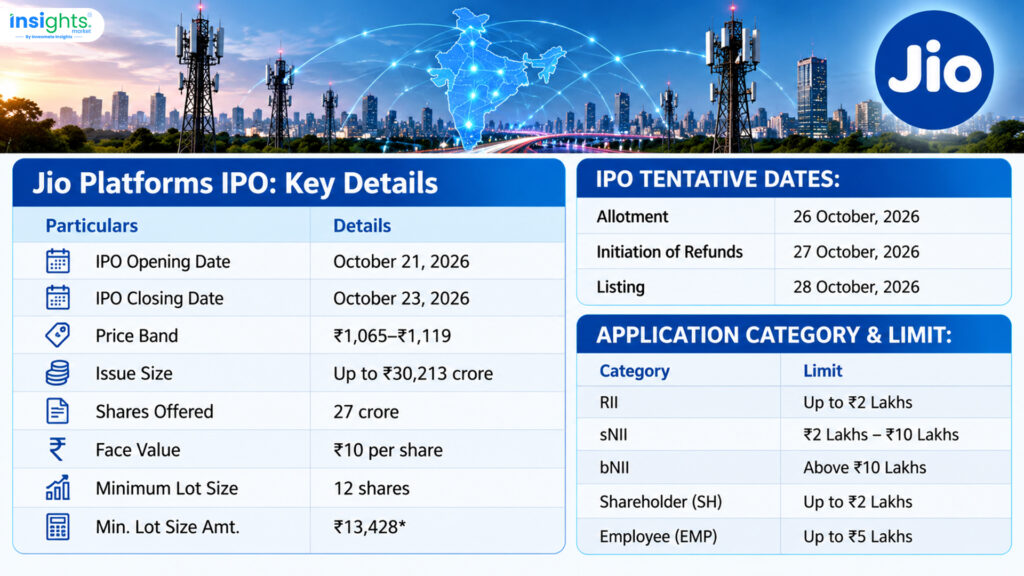
Jio Platforms Ltd.’s IPO is a book-built issue worth ₹30,213 crore, comprising an entirely fresh issue of 27 crore equity shares.
Business Overview: Telecom, Broadband and Digital Ecosystem
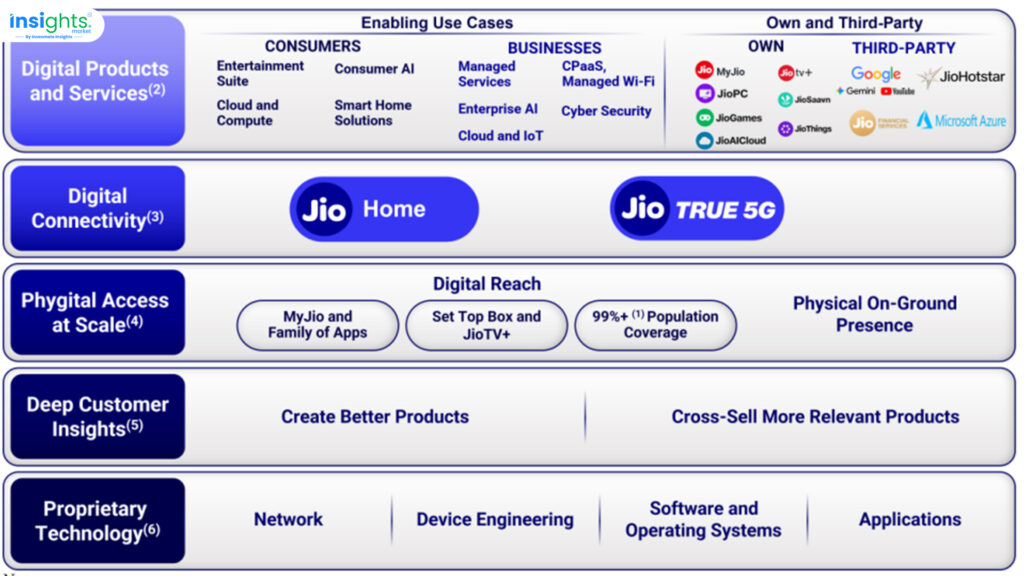
Jio Platforms operates an integrated digital ecosystem spanning mobile connectivity, 4G and 5G services, home broadband, digital applications and enterprise technology solutions. As of June 2026, it served 533.3 million customers, with its network carrying approximately 60% of India’s wireless data traffic in FY26. Its wireless network covered over 99% of India’s population, while its fixed broadband services reached approximately 98% of the country’s pin codes. JioFiber and JioAirFiber had a combined customer base of 28.6 million, creating opportunities for further growth in home broadband. The company offers digital services through MyJio, JioTV+, JioSaavn and JioGames. As of June 2026, JioTV+ aggregated more than 1,000 digital TV channels and 15 OTT services. Its enterprise offerings include cloud services, managed Wi-Fi, cybersecurity, private 5G, VPN and communication solutions. Technology and innovation remain important to its business model. As of June 30, 2026, the company and its subsidiaries had filed 7,220 patent applications, of which 1,043 had been granted. Its technology initiatives include an indigenous 5G technology stack, the proprietary JioBrain AI platform and Fixed Wireless Access (FWA) technology. These capabilities support network development, digital service expansion and potential future growth.
Growth Opportunities: 5G, Broadband and AI
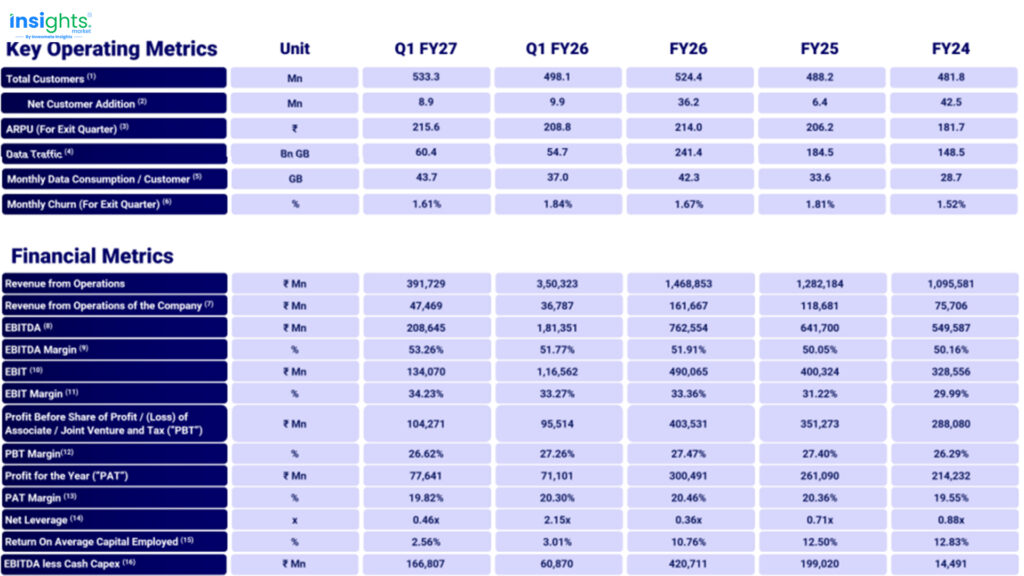
India’s digital economy is projected to grow from ₹49.6 trillion in FY26 to ₹125.8 trillion by FY31, creating opportunities across connectivity, broadband and digital services. The mobile connectivity market is expected to expand from ₹2.9 trillion to ₹5.2 trillion, while monthly data consumption per customer could increase from 26.7 GB to 59.2 GB by FY31. Jio’s ARPU increased from ₹214 per month at the end of FY26 to ₹215.6 in Q1 FY27, indicating gradual improvement in revenue per user. Fixed broadband customers are projected to reach 150.4 million, supported by rising demand for high-speed internet and Fixed Wireless Access (FWA). Enterprise business applications and solutions are expected to grow at a 23% CAGR, while smart-home IoT could expand at 27%. These trends create opportunities to increase ARPU, expand JioAirFiber and home broadband adoption, and monetise AI, cloud, IoT and enterprise services. International expansion of proprietary technology platforms could provide another growth avenue.
Financial Performance and Key Operating Metrics
Jio Platforms recorded a 15.8% revenue CAGR and approximately 18.5% net profit CAGR between FY24 and FY26. Operationally, its customer base grew from 481.8 million to 524.4 million, while monthly data consumption per user increased from 28.7 GB to 42.3 GB. ARPU also improved from ₹181.7 to ₹214, reflecting higher customer monetisation.
Valuation: Is the Price Attractive?
At the upper price band of ₹1,119, Jio Platforms is valued at approximately 33.19x FY26 earnings on a post-issue basis. This valuation reflects its large customer base, strong margins, and growth opportunities. Among listed peers, Bharti Airtel reported higher revenue and EBITDA in FY26, while Jio Platforms generated higher net profit and reported a lower P/E multiple in the peer comparison. Future growth is likely to be driven by tariff revisions, customer migration from 2G to 4G and 5G, rising data consumption, expansion of home broadband, and wider enterprise adoption of cloud and digital solutions. The IPO proceeds are expected to be used primarily to repay or prepay certain borrowings of Reliance Jio Infocomm, with approximately ₹27,500 crore earmarked for this purpose. Reducing borrowings could help lower interest costs and strengthen financial flexibility.
Key Risks Investors Should Consider
Despite its strong market position, Jio Platforms faces several risks. Telecom operations require ongoing investment in spectrum, networks, and technology infrastructure. Intense competition and slower-than-expected tariff increases, which could affect cash flow and investment returns. Dependence on a limited group of infrastructure providers may disrupt network expansion and service availability. Cybersecurity incidents, data privacy issues and network outages could also disrupt services and damage customer confidence. The business also depends on telecom licenses and spectrum rights, making timely renewals and regulatory compliance critical. In addition, Natural disasters, power failures, fibre cuts, equipment breakdowns or software issues could affect network availability and service quality. Prolonged outages may lead to customer attrition, compensation claims, regulatory action and reputational damage.
GMP Trend
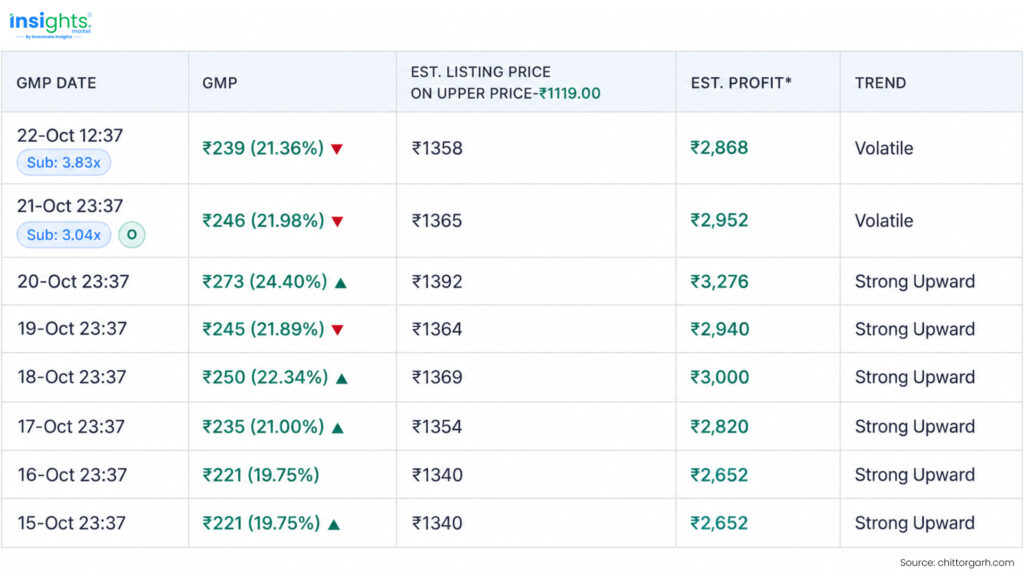
Jio Platforms IPO’s Grey Market Premium (GMP) remained strong before opening the issue. As of Day 2 (12.37 PM), the latest GMP indicated an estimated listing price of ₹1358, implying a 21.36% premium. However, GMP is unofficial and can fluctuate before listing, so it does not guarantee listing gains.
Final Overview
Jio Platforms is entering the public market with a strong presence in India’s telecom and digital services industry. Its large customer base, expanding 5G network and growing broadband, AI and enterprise services offer significant growth opportunities. Consistent revenue and profit growth further support its business outlook. However, investors should also consider the IPO valuation, high capital expenditure, competition and regulatory risks before making an investment decision.
FAQs
The Jio Platforms IPO is a book-built issue worth up to ₹30,213 crore, comprising a fresh issue of 27 crore equity shares.
The IPO is scheduled to open on October 21, 2026, and close on October 23, 2026.
The price band is ₹1,065 to ₹1,119 per share.
The minimum lot size is 12 shares. At the upper price band of ₹1,119, the minimum investment is ₹13,428.
The company plans to use approximately ₹27,500 crore to repay or prepay certain borrowings of Reliance Jio Infocomm Ltd. The remaining proceeds may be used for general corporate purposes.
Its business spans mobile connectivity, 4G and 5G services, home broadband, digital applications, cloud services, cybersecurity and enterprise technology solutions.
As of October 19, 2026, the Grey Market Premium (GMP) stood at ₹245 per share, indicating an estimated listing price of ₹1,364 at the upper price band. GMP is unofficial and may change before listing.
Key risks include high capital expenditure, intense competition, regulatory and spectrum-related requirements, dependence on network infrastructure providers, cybersecurity threats and potential service disruptions.
This article is for educational and informational purposes only. It is not investment advice or a stock recommendation. Investors should conduct their own research or consult a qualified financial advisor before making investment decisions.