



India’s growing electricity demand and expanding industrial activity continue to support the country’s coal sector. Despite the increasing adoption of renewable energy, coal remains a critical part of India’s energy mix, particularly for thermal power generation. Against this backdrop, Mahanadi Coalfields Limited (MCL), one of India’s largest coal-producing companies, is entering the capital market through an Offer for Sale (OFS) of approximately ₹8,981.12 crore. The IPO values the company at approximately ₹90,010 crore at the upper price band. However, since the issue is entirely an OFS, MCL will not receive any proceeds from the IPO. In this blog, we analyze the company’s business model, production capacity, industry outlook, financial performance, valuation, and key risks to understand its overall business prospects.
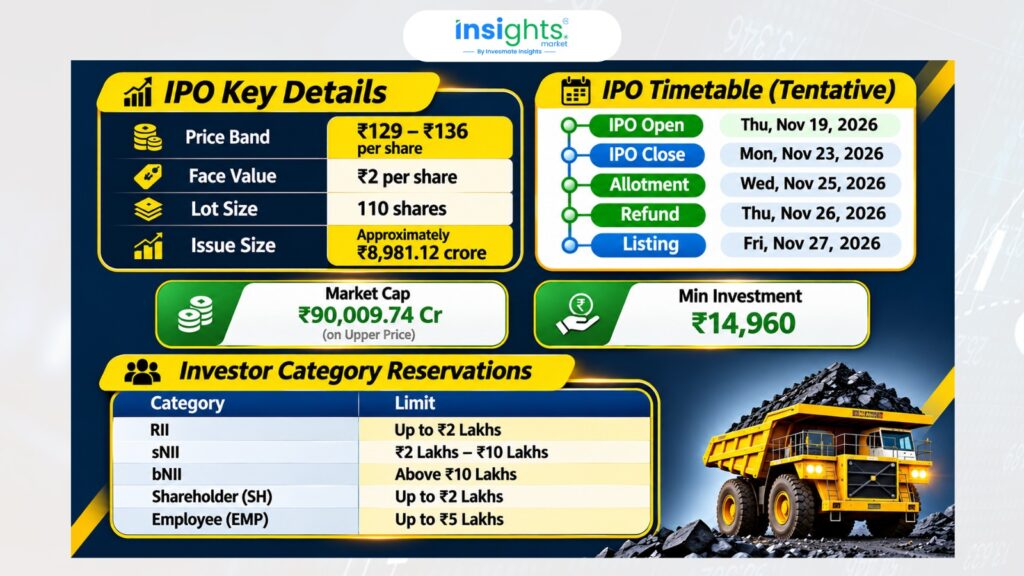
Key IPO Details
Mahanadi Coalfields’ IPO is a book-built issue comprising an Offer for Sale of 66.18 crore equity shares. The issue does not include any fresh issue of shares. Therefore, the entire proceeds will go to the selling shareholder, Coal India Limited, rather than to MCL.
Company Overview
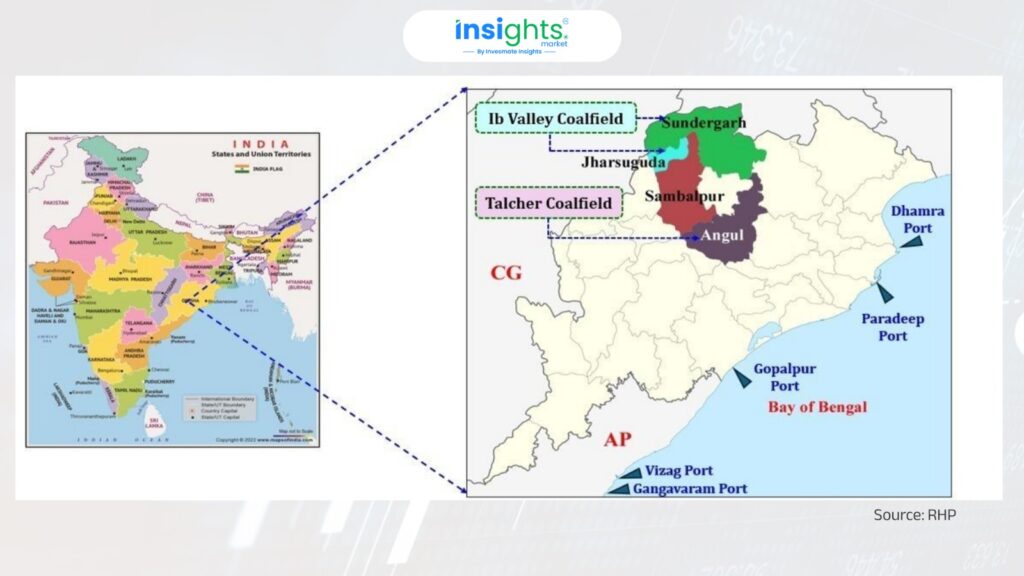
Mahanadi Coalfields Limited is a wholly owned subsidiary of Coal India Limited. The company was carved out of South Eastern Coalfields Limited to strengthen coal production from the Talcher and Ib Valley coalfields in Odisha. MCL is primarily engaged in mining thermal-grade non-coking coal, which is mainly used for electricity generation. It also supplies coal to other industries, including cement, steel, aluminium and sponge iron. As of FY26, MCL was India’s largest single coal-producing company, contributing approximately 21% of the country’s total domestic coal production. It was also the largest coal producer among Coal India’s subsidiaries, accounting for around 28% of its parent company’s total coal production. The company operates 17 mines, comprising 14 opencast mines and three underground mines. Its operations are supported by mechanised mining equipment, railway connectivity, and dedicated coal transportation infrastructure.
Business Operations and Revenue Model
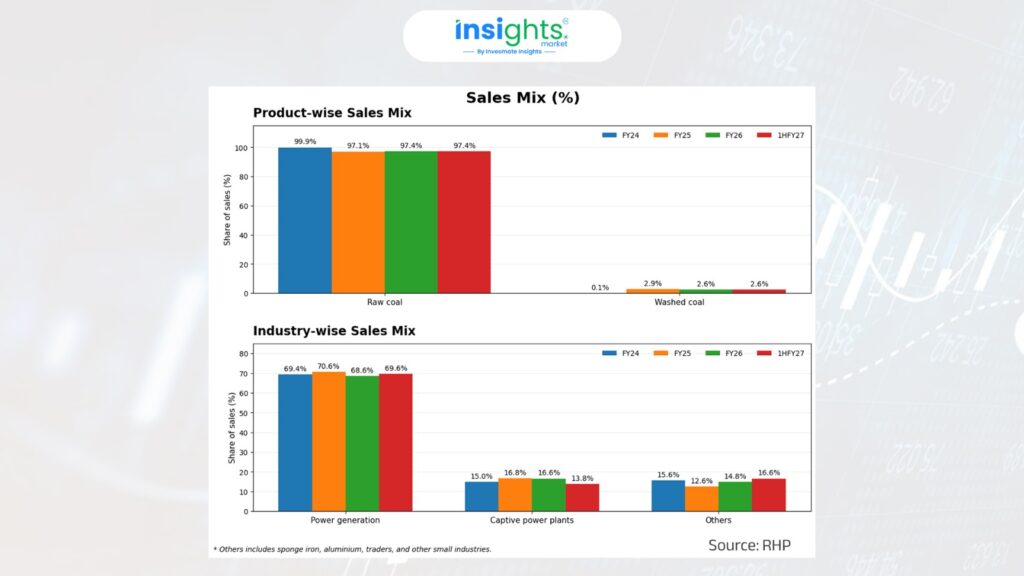
MCL generates most of its revenue through the sale of raw coal to thermal power utilities, captive power plants, and industrial customers. Its sales are primarily supported by long-term Fuel Supply Agreements (FSAs). These agreements provide a relatively stable customer base and support demand visibility. Raw coal contributed approximately 97.4% of product sales in FY26, while washed coal accounted for 2.6%. The company operates a 10 MTPA coal washery at Ib Valley and plans to expand its total washery capacity to 37 MTPA through two additional projects. Power generation remained its largest customer segment, contributing 68.6% of product sales in FY26, followed by captive power plants at 16.6%.
Coal Production Capacity and Market Position
MCL has estimated coal resources of approximately 40.34 billion tonnes, representing around 9.8% of India’s total coal resources. The company produced 218.31 million tonnes of coal in FY26, compared with 225.17 million tonnes in FY25. Coal dispatch stood at approximately 210.7 million tonnes. Its predominantly mechanised opencast mining operations and favourable mining locations support efficient production and lower operating costs. MCL also benefits from railway connectivity across three railway zones and access to five ports, supporting coal transportation and distribution.
Financial Performance
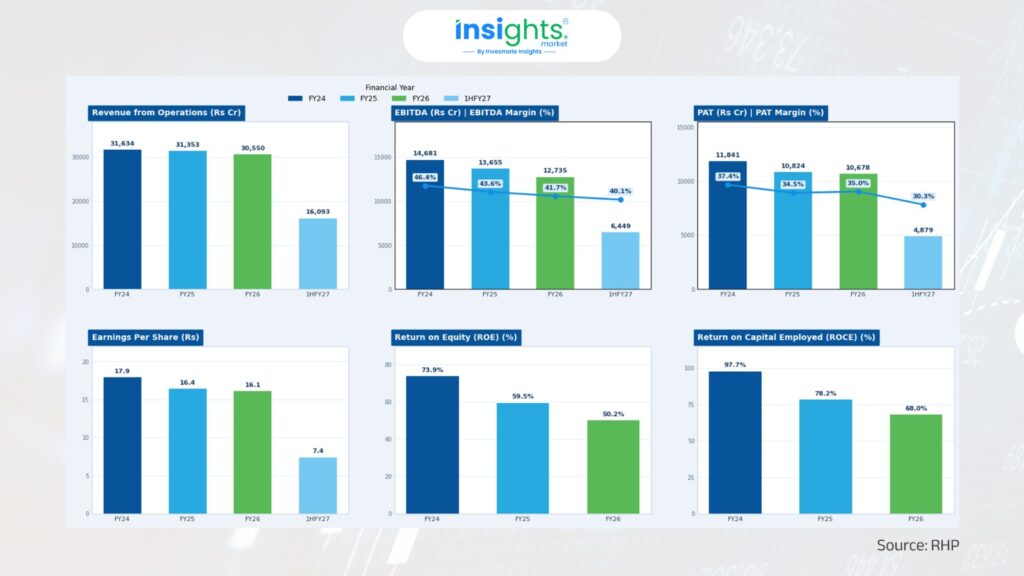
MCL has maintained strong profitability, supported by its large production scale and relatively low-cost mining operations. However, its financial performance over the last few years indicates some pressure on revenue and operating margins.
Valuation Analysis
At the upper price band of ₹136, MCL is valued at an estimated post-issue market capitalisation of ₹90,010 crore. Based on FY26 earnings, its P/E stands at approximately 9.22x, while EV/EBITDA is 5.9x on post issue basis. The P/B ratio is approximately 4.2x. These valuations appear moderate on earnings and EBITDA parameters. However, the declining revenue and operating margins should also be considered while assessing the company’s valuation
Key Strengths and Growth Opportunities
MCL’s key strengths include its leading position in India’s coal industry, a large resource base of approximately 40.34 billion tonnes and strong parentage from Coal India Limited. Its predominantly mechanised opencast mining operations, favourable mining locations, and established railway connectivity support efficient production and coal dispatch. The company also has a strong financial position, with negligible debt, healthy cash flow and a consistent dividend track record. Going forward, MCL plans to expand its washery capacity from 10 MTPA to 37 MTPA through two new projects, which could increase washed coal production and diversify its product portfolio. Expansion of existing mines, development of new mining projects and improvements in coal evacuation infrastructure could further support operational growth. Additionally, the company is exploring opportunities in renewable energy, including a planned 2,000 MW solar power project, 100 MW wind power project and 500 MW pumped storage project, along with potential opportunities in coal gasification, other mineral mining and rare earths.
Key Risks and Challenges
MCL faces certain business and operational risks despite its strong market position. The company remains highly dependent on the thermal power sector, which contributed approximately 68.6% of product sales in FY26, while raw coal accounted for around 97.4%, indicating limited customer and product diversification. Increasing renewable energy adoption could gradually affect long-term coal demand. Additionally, MCL depends on third-party mining contractors for a significant portion of its operations, with contractual expenses accounting for approximately 22% of revenue in FY26. The company also reported contingent liabilities of around ₹8,506 crore, equivalent to nearly 40% of its net worth, which could impact its financial position if they materialise. Environmental regulations, land acquisition, employee safety, and operational disruptions remain other key challenges. Furthermore, India’s non-coking coal deficit is projected to turn into a surplus of around 122 million tonnes by FY36, potentially increasing competition and putting pressure on coal prices and realisations.
Conclusion
Mahanadi Coalfields has a strong position in India’s coal industry, supported by its large resource base, production capacity, Coal India backing, and healthy cash generation. Its negligible debt and consistent dividend payments are additional strengths. However, declining revenue and EBITDA, high dependence on thermal power, and long-term energy transition risks remain important concerns. At approximately 9.22x FY26 earnings, the valuation appears moderate, but investors should also consider the company’s earnings trend and future growth opportunities while assessing its overall business prospects.
FAQs
Mahanadi Coalfields Limited is a wholly owned subsidiary of Coal India Limited, incorporated in 1992. It is primarily engaged in mining non-coking coal from the Talcher and Ib Valley coalfields in Odisha.
The IPO comprises an Offer for Sale of 66.18 crore equity shares, amounting to approximately ₹8,981.12 crore.
The IPO is entirely an Offer for Sale (OFS). Coal India Limited is selling 10% of its stake in MCL, and the company will not receive any proceeds from the issue.
At the upper price band of ₹136 per share, MCL is estimated to have a post-issue market capitalisation of approximately ₹90,010 crore.
MCL produced approximately 218.31 million tonnes of coal in FY26, making it India’s largest single coal-producing company by production.
MCL primarily generates revenue through the sale of raw non-coking coal to thermal power utilities, captive power plants and other industries. Raw coal contributed approximately 97.4% of product sales in FY26.
MCL reported revenue from operations of ₹30,550 crore, EBITDA of ₹12,735 crore and net profit of ₹10,678 crore in FY26.
Key risks include high dependence on thermal power and raw coal sales, the transition towards renewable energy, contractor dependency, contingent liabilities and the possibility of a future domestic coal supply surplus.
This article is for educational and informational purposes only. It is not investment advice or a stock recommendation. Investors should conduct their own research or consult a qualified financial advisor before making investment decisions.