


If you checked your portfolio recently, you may have seen two completely different stories.
AI-linked stocks were flying. IT majors were falling.
Same market. Same day. Opposite direction.After Nvidia’s India announcements, the divergence became impossible to ignore.
So what is really happening here?
Is AI replacing Indian IT — or is the market simply rotating?
Let’s simplify this.
The Trigger: Nvidia’s India Push
At the AI Impact Summit in Delhi, Nvidia announced multiple India-focused partnerships.
One key partner was Netweb Technologies, which will launch AI supercomputing systems built on Nvidia’s Grace Blackwell architecture.
At the same time:
- Yotta announced plans to invest over $2 billion in Nvidia Blackwell Ultra chips.
- India’s AI infrastructure build-out narrative strengthened.
The message was simple: India is building serious AI infrastructure. And the market reacted instantly.
Why Nvidia-Linked AI Stocks Are Flying
Think of AI like a gold rush.In every gold rush, there are two types of businesses: The ones selling the tools — shovels, machines , The ones using those tools to provide services.
Right now, investors are rushing toward the tool sellers.
Money is flowing first into: GPUs , AI servers ,Data centres , Power and cooling infrastructure
Not into software billing models — at least not yet.
That’s why stocks like:
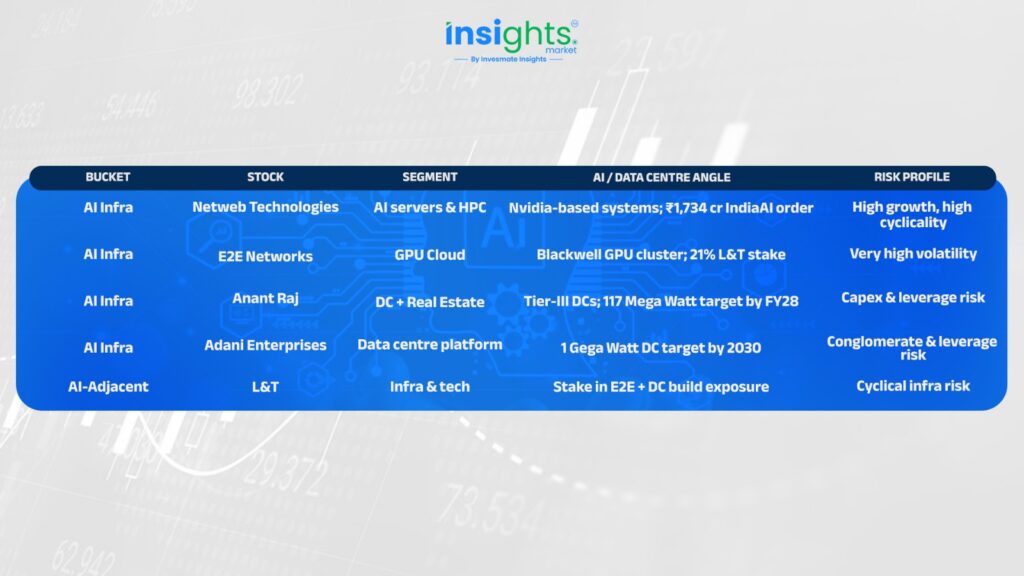
- Netweb Technologies – AI servers & supercomputers
- E2E Networks – GPU cloud rental
- Anant Raj – data centre + real estate
- Adani Enterprises (via AdaniConneX) – data centre platform
- Larsen & Toubro – infra + AI exposure
have been in focus. Netweb alone is up nearly 97% over the past year.
There are three simple reasons investors are chasing these names:
1. Direct AI Capex Exposure
These companies are directly linked to AI infrastructure spending. If India builds more AI supercomputers and data centres, they receive the orders.
Orders are visible. Revenue is measurable.Markets reward visibility.
2. The “Picks and Shovels” Advantage
Investors are thinking:
No matter which AI model wins, GPUs and data centres will be needed.
So instead of betting on which AI software company dominates, they prefer the infrastructure layer.
3. Scarcity Premium
India has very few listed pure-play AI infrastructure names. When demand for AI exposure rises, money crowds into the same limited stocks. That crowding effect creates sharp spikes.
AI vs IT: Two Buckets Every Investor Should Know
Here’s a simplified watchlist across both sides.
AI Infrastructure & AI-Adjacent Names
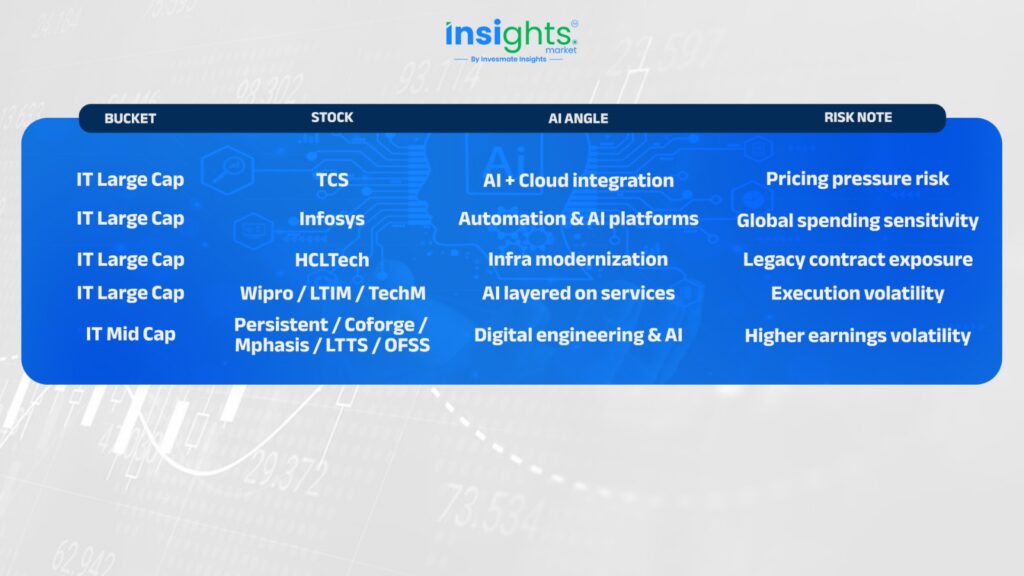
Large & Mid-Cap IT Services
Meanwhile, Why Did IT Giants Fall?
Large IT companies like TCS, Infosys, HCL Technologies, and Wipro earn money mainly by deploying engineers, writing cod,e and managing IT systems.
Now investors are asking:
If AI can write code and automate tasks, will companies need fewer engineers?
That fear is driving selling pressure.
Over the last year, most large IT names delivered negative returns.
1-Year Snapshot (1 Feb 2025 – 19 Feb 2026)
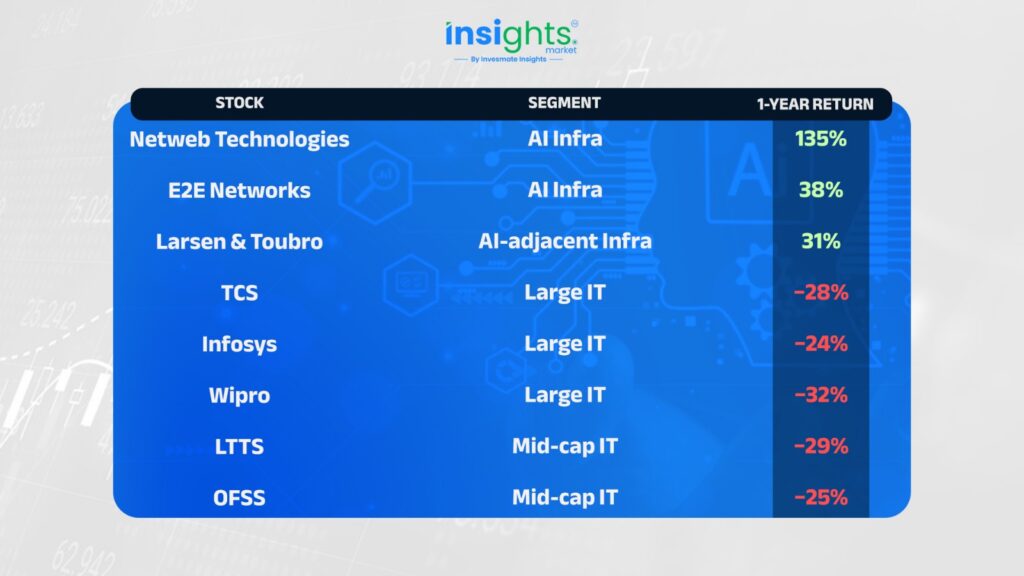
The divergence is clear.
AI infrastructure stocks are being rewarded.
Traditional IT services are being derated.
So… Is AI Replacing Indian IT?
Short answer: No. It is changing it.
When cloud computing arrived, many believed IT services would collapse.
Instead, companies adapted. They built cloud consulting, migration and security businesses.
AI is likely to follow a similar path.
Clients will need:
- AI integration
- AI governance
- AI consulting
- Data preparation
Large IT firms are well-positioned to deliver these.
The real issue is that AI may reduce manpower-based billing. Growth may become more automation-driven and margin-sensitive.
This is a transition phase.
Markets dislike uncertainty, and that is what we are seeing now.
What Should Investors Watch?
For AI infra names, track:
- Order book growth
- Revenue growth above 25–30%
- Operating margins
- Debt levels
- Client concentration
- Cash flow
If growth slows while valuations stay high, risk increases.
For IT services, watch:
- Large deal wins
- Utilisation rates
- Attrition
- AI revenue contribution
These will indicate whether AI is adding revenue or replacing it.
Final Thought
This is not: AI is good, IT is bad.
This is:
AI infra = immediate growth visibility
IT services = business model transition
Markets reward certainty. They discount uncertainty.
AI is not killing Indian IT. It is creating winners and forcing transitions.
And in markets, transitions create both risk and opportunity.
FAQs
No, AI is not replacing Indian IT companies, but it is changing how they operate. Traditional IT models based on manpower billing may face pressure as AI automates coding and support tasks. However, AI also creates new opportunities in AI consulting, integration, governance, and cloud transformation. The sector is going through a transition, not a collapse.
AI-related stocks are rising because Nvidia’s India partnerships signal increased spending on AI infrastructure such as GPUs, servers, and data centres. Companies directly linked to AI hardware, GPU cloud, and data centre expansion are seen as immediate beneficiaries of this capital expenditure cycle. Investors prefer businesses with visible order books and revenue growth.
IT stocks are falling due to concerns that AI automation could reduce manpower-based billing and compress margins. Meanwhile, AI infrastructure stocks are rising because they benefit directly from AI-related capital spending. The market is currently rewarding near-term earnings visibility and discounting uncertainty in IT services.
Companies involved in AI servers, GPU cloud services, data centres, and power infrastructure are considered beneficiaries. These include firms building AI supercomputers, operating GPU cloud platforms, expanding data centre capacity, and supplying electrical or cooling systems required for large AI facilities.
It depends on risk appetite. AI infrastructure stocks may offer higher growth but come with higher volatility and valuation risk. IT services stocks may offer relatively stable cash flows but are currently facing transition-related uncertainty. A balanced allocation between both segments may help manage risk.
Key risks include high valuations, dependence on large orders, rising debt due to heavy capital expenditure, and potential slowdown in AI spending. Since AI infrastructure stocks have rallied sharply, even a slight slowdown in growth could lead to sharp corrections.
This article is for educational and informational purposes only. It is not investment advice or a stock recommendation. Investors should conduct their own research or consult a qualified financial advisor before making investment decisions.