


India’s mutual fund industry is growing rapidly, supported by rising financial awareness, increasing SIP investments, digital platforms, and higher participation in financial assets. Riding this trend, SBI Funds Management Limited (SBIFM), the asset manager of SBI Mutual Fund and India’s largest AMC by Assets Under Management (AUM), has launched its Initial Public Offering (IPO). Unlike many recent IPOs, this is an opportunity to invest in India’s long-term wealth creation story. In this article, we’ll discuss the company’s business model, IPO details, industry outlook, financial performance, key growth drivers, risks, and whether the valuation offers a compelling investment opportunity.
About the company
SBI Funds Management Ltd. is India’s largest Asset Management Company (AMC) by AUM and manages SBI Mutual Fund. It is a joint venture between State Bank of India (SBI) and Amundi Asset Management, Europe’s largest asset manager. The company offers a wide range of investment products, including equity, debt, hybrid funds, ETFs, index funds, liquid funds, overseas funds, and Portfolio Management Services (PMS). As of FY26, it served over 1.8 crore investors through 126 mutual fund schemes across retail and institutional segments. It also has a growing global presence, managing India-focused investment mandates and advisory services for institutional investors across Japan, Australia, Korea, and Europe.
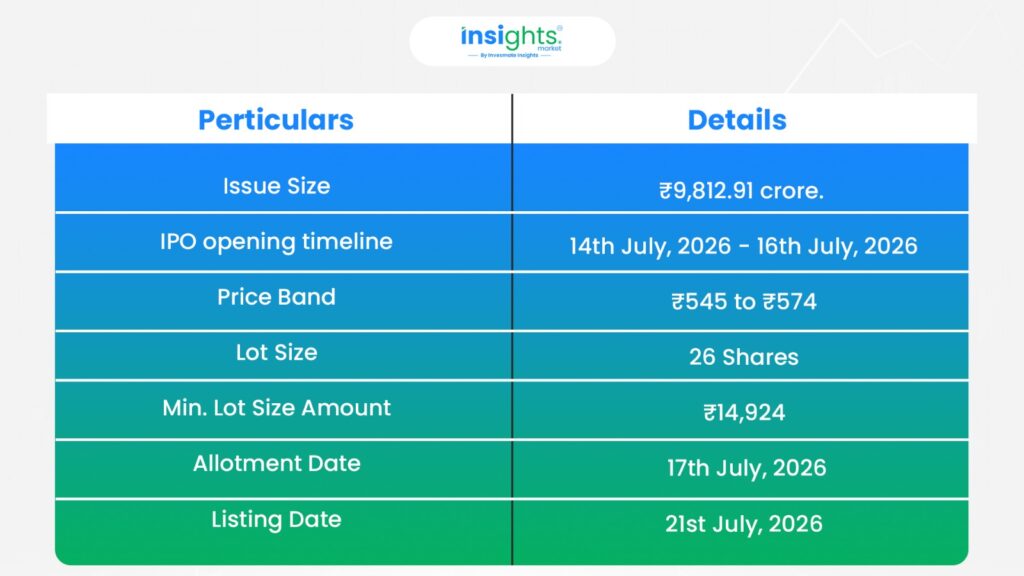
Quick IPO Details
The SBI Funds Management IPO is a 100% Book Built Offer consisting entirely of an Offer for Sale (OFS) by the existing promoter shareholders.
Industry Outlook
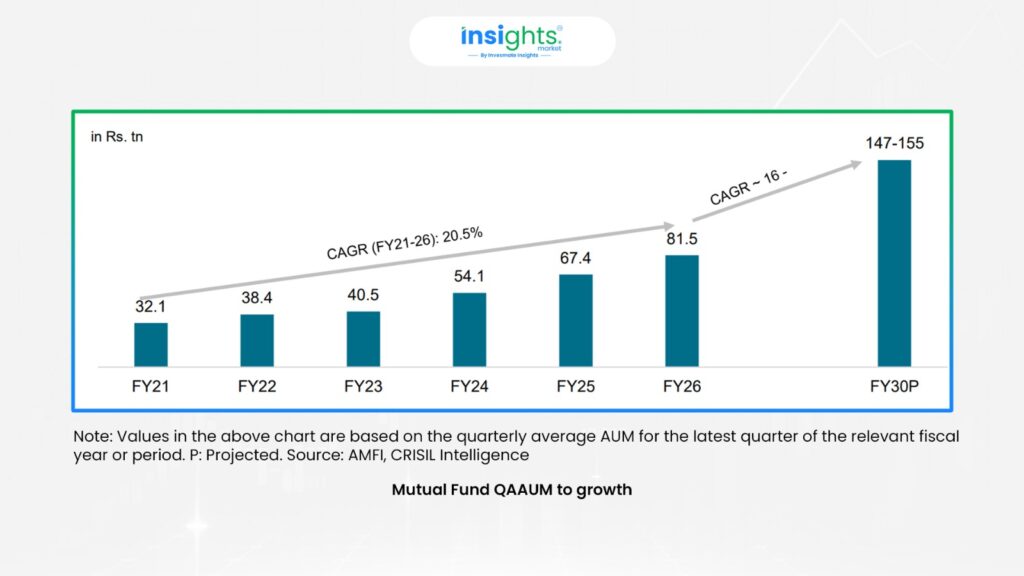
India’s asset management industry is entering a strong long-term growth phase, supported by rising financial awareness, increasing SIP investments, digital investing, and a gradual shift of household savings towards financial assets. The industry’s Mutual Fund AUM-to-GDP ratio has improved from 16.2% in FY21 to 23.2% in FY26, showing growing market penetration. As of March 2026, SIP assets reached ₹15.1 trillion with 104.5 million SIP accounts, contributing nearly 60% of equity and equity-hybrid fund inflows. Retail investors now account for 62.8% of the industry’s AUM, while B-30 cities continue to see strong growth. Looking ahead, the industry is expected to benefit from rising SIP inflows and growing adoption of ETFs, Index Funds, and Specialized Investment Funds (SIFs), along with supportive regulations such as Mutual Fund Lite. Although market volatility and regulatory changes remain key risks, favourable demographics, rising incomes, and increasing investor participation are expected to support the industry’s long-term growth.
Why SBI Funds Management Stands Out
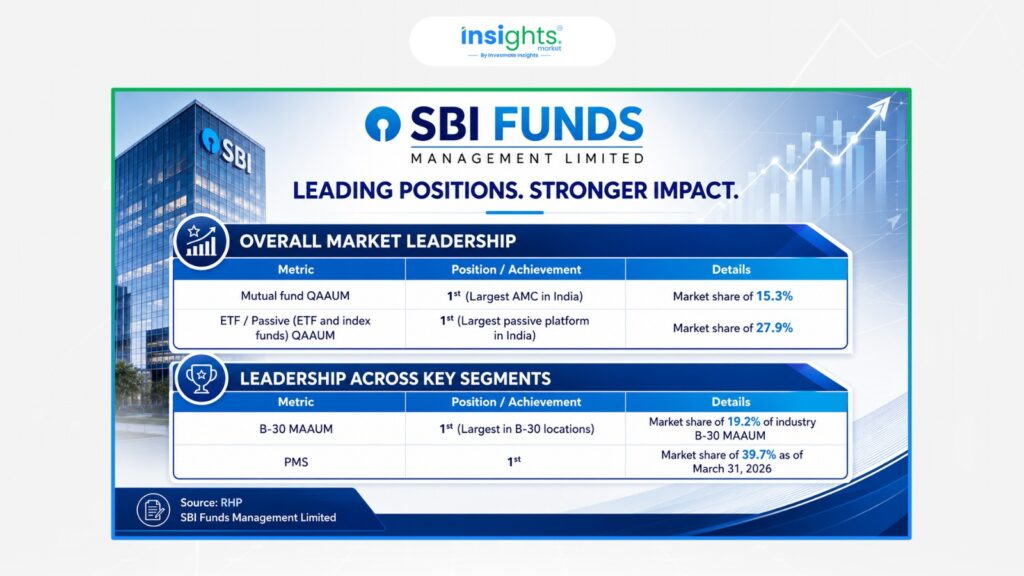
SBI Funds Management has built one of India’s strongest asset management businesses over the past three decades. As of FY26, it is the largest mutual fund asset manager in India by Quarterly Average Assets Under Management (QAAUM), with a 15.3% market share. It is also the market leader in passive investment products, including ETFs and Index Funds, with a 27.9% market share. The company’s leadership goes beyond mutual funds. It has the largest presence in B-30 (Beyond Top-30) cities, helping it reach investors across smaller towns and cities. It also has the largest Portfolio Management Services (PMS) business in India, with a 39.7% market share as of March 31, 2026. These leadership positions reflect SBI Funds Management’s strong brand, wide distribution network, and ability to serve both retail and institutional investors.
Diversified Business Model
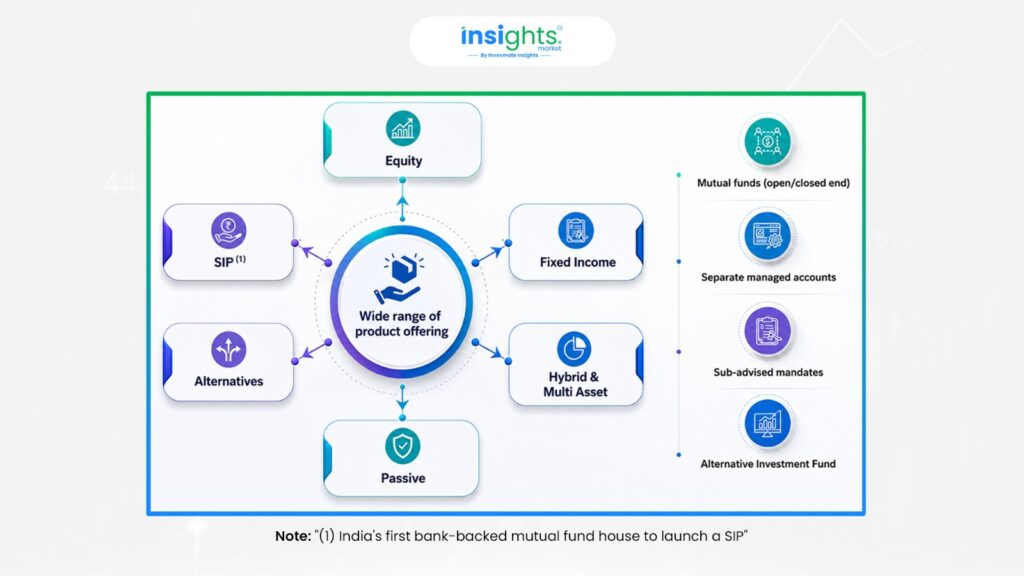
The company’s strength extends beyond its market leadership. SBI Funds Management offers one of the most diversified investment platforms in India, catering to both retail and institutional investors. Its product portfolio spans Equity, Fixed Income, Hybrid & Multi-Asset Funds, Passive Funds (ETFs & Index Funds), Alternative Investments, and Specialized Investment Funds (SIFs). Beyond mutual funds, it also provides Portfolio Management Services (PMS), Alternative Investment Funds (AIFs), Separate Managed Accounts, and International Sub-advisory Mandates. This diversified product mix allows the company to benefit from multiple growth opportunities while reducing dependence on any single investment category.
Financial Snapshot
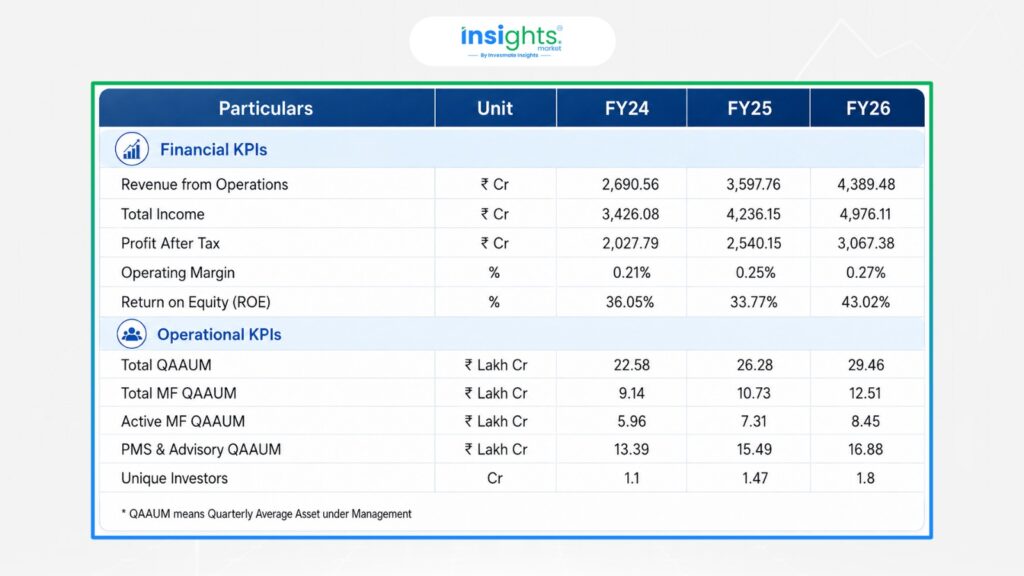
SBI Funds Management has delivered consistent growth in assets under management and profitability over the last few years, reflecting the structural expansion of India’s mutual fund industry and its strong market position. The table below highlights some of the company’s key financial metrics.
Growth Strategies
To strengthen its leadership position and capture future growth opportunities, SBI Funds Management plans to focus on the following strategic priorities:
- Deepen retail penetration by expanding investor reach in underserved markets through SBI’s extensive branch network and distribution ecosystem.
- Strengthen digital capabilities by investing in technology, digital platforms, and automation to improve investor experience and operational efficiency.
- Expand the product portfolio by introducing new investment solutions across mutual funds, ETFs, Index Funds, PMS, AIFs, and Specialized Investment Funds (SIFs).
- Scale the passive investment business by launching new equity index funds, thematic and smart beta ETFs, fixed-income ETFs, target maturity funds, international ETFs, and commodity ETFs.
- Grow the alternative investment platform by expanding Portfolio Management Services (PMS), Alternative Investment Funds (AIFs), and institutional advisory solutions.
- Capture global opportunities by leveraging its partnership with Amundi and expanding offshore products, cross-border investment solutions, and international institutional mandates.
Key Risk Factors
- Market-Linked Earnings: Revenue and profitability depend heavily on Quarterly Average Assets Under Management (QAAUM). Market corrections, investor redemptions, or lower inflows could reduce AUM and impact earnings.
- Capital Market Volatility: Weak equity or debt markets may lead to lower management fees, higher investor withdrawals, reduced SIP inflows, and overall pressure on financial performance.
- Concentration Risk: A significant portion of the company’s AUM and revenue comes from a limited number of mutual fund schemes. Underperformance or large redemptions in these schemes could adversely affect the business.
- Regulatory & Compliance Risk: The company operates in a highly regulated industry. Any failure to comply with SEBI regulations or other regulatory requirements could result in penalties, reputational damage, or operational restrictions.
- Regulatory Changes: Changes in mutual fund regulations, compliance requirements, or adverse findings during SEBI inspections could increase operating costs and negatively impact future business growth.
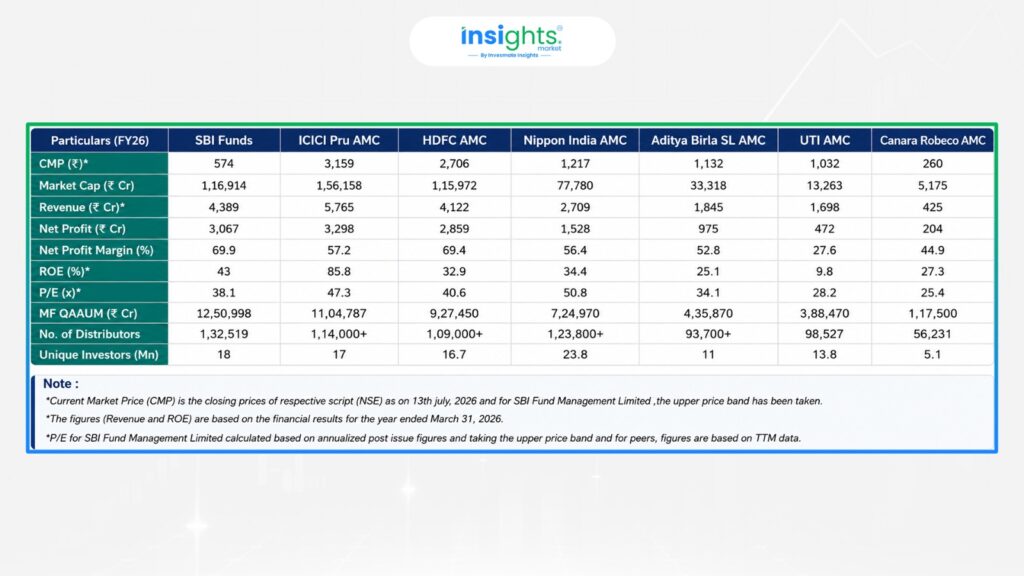
PEER COMPARISON
Conclusion
SBI Funds Management offers investors exposure to one of India’s strongest long-term growth themes, the rising financialisation of household savings. Backed by the trusted SBI brand, a leading market position, diversified investment offerings, and strong financial performance, the company is well placed to benefit from the continued expansion of India’s mutual fund industry. However, investors should also consider factors such as valuation, market-linked earnings, and regulatory risks before making an investment decision. For those with a long-term perspective, the IPO provides an opportunity to participate in India’s largest asset management company and the structural growth of the country’s investment ecosystem
FAQs
SBI Funds Management is India’s largest asset management company (AMC) by AUM. It manages SBI Mutual Fund and offers mutual funds, ETFs, index funds, PMS, AIFs, and other investment solutions for retail and institutional investors.
The IPO is entirely an Offer for Sale (OFS). The company will not receive any proceeds, as existing shareholders are selling the shares.
SBI Funds Management is promoted by State Bank of India (SBI) and Amundi Asset Management, Europe’s largest asset manager.
The company primarily earns management fees based on the assets it manages. As AUM grows through new investments and market appreciation, its revenue generally increases.
Key growth drivers include rising SIP investments, increasing mutual fund penetration, digital investing, expansion of passive funds, growing demand for alternative investments, and a strong distribution network.
Major risks include market volatility, lower AUM due to redemptions or market corrections, regulatory changes, and increasing competition in the asset management industry.
No. Besides mutual funds, the company also offers Portfolio Management Services (PMS), Alternative Investment Funds (AIFs), offshore investment products, and institutional advisory services.
The IPO may appeal to long-term investors seeking exposure to India’s growing asset management industry. However, investors should evaluate the company’s valuation, business fundamentals, and risks before making an investment decision
This article is for educational and informational purposes only. It is not investment advice or a stock recommendation. Investors should conduct their own research or consult a qualified financial advisor before making investment decisions.