


The Call That Changed Everything
Imagine running a diamond polishing unit in Surat. For months, you’ve watched orders dry up. Your workers—artisans who’ve spent decades perfecting their craft—are sitting idle. The reason? A 50% tariff wall between your products and your biggest customer: America.
Then, on February 2nd, at 11 PM, your phone buzzes. “Trump announces deal with Modi. Tariffs down to 18%.”
Within hours, GIFT Nifty surges 800 points. Your buyers in New York are calling. Orders are back on the table.
This isn’t fiction. This is what happened to thousands of Indian exporters last night when President Trump and PM Modi announced a landmark trade agreement—one that could reshape $86.5 billion worth of annual exports and millions of jobs across India.
What Just Happened: The Deal in 60 Seconds
The Announcement:
- Reciprocal tariff reduced: 25% → 18%
- Russian oil penalty removed: Additional 25% surcharge eliminated
- Net effect: Total tariff burden drops from 50% to 18% (a 64% reduction)
- India’s commitment: Stop Russian oil purchases + $500 billion in US goods over 5 years
The Timeline:
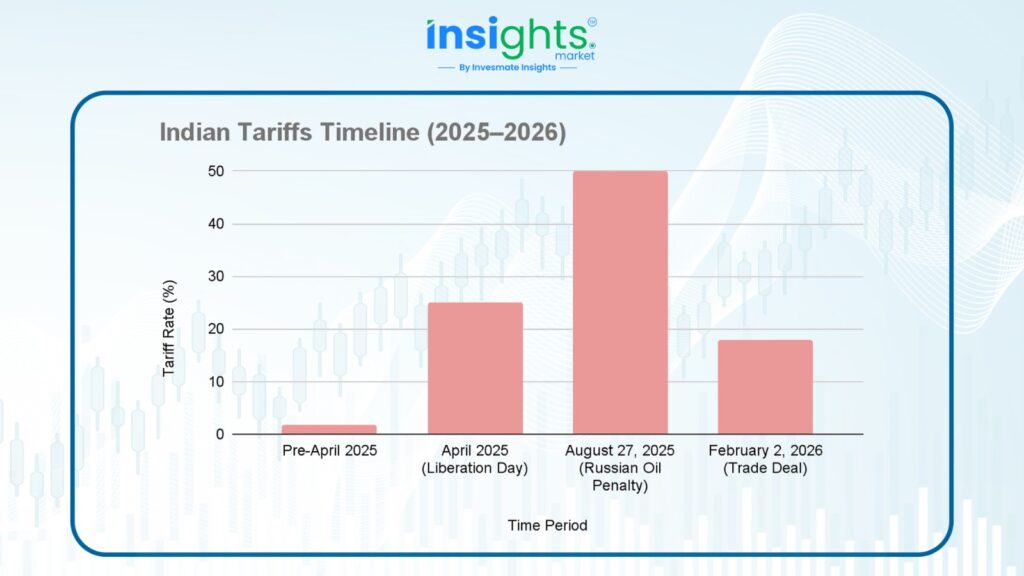
- April 2, 2025: Trump imposed 26% “reciprocal” tariffs on Indian goods
- August 27, 2025: Added 25% penalty for Russian oil purchases (total: 50%)
- February 2, 2026: Deal announced, bringing rates down to 18%
Tariff Progression on Indian Goods: From 1.8% to 50% and Back to 18%
Why This Matters Beyond the Headlines
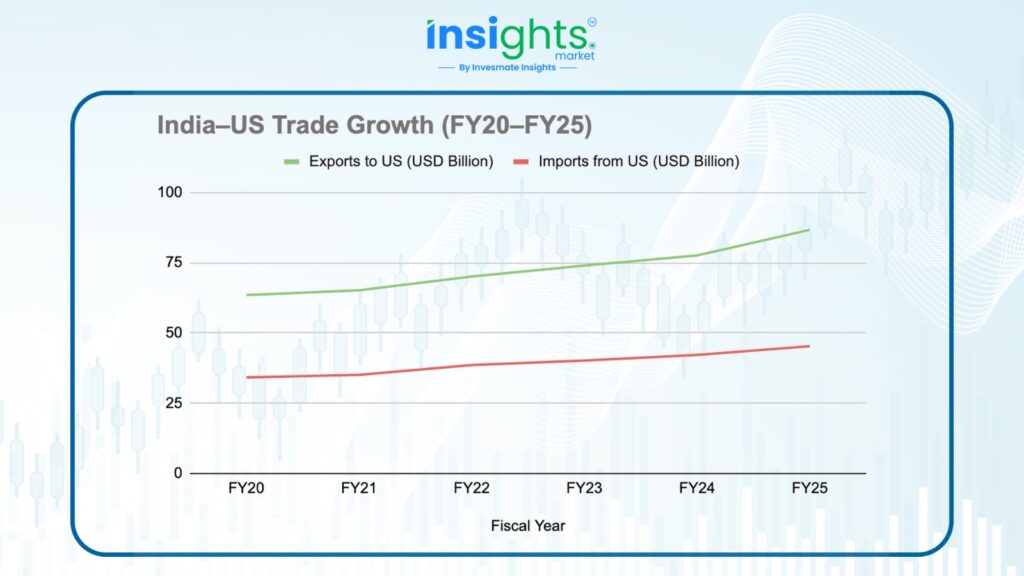
The United States is India’s largest export destination—accounting for 18% of all Indian exports. When tariffs jumped from 1.8% to 50% over ten months, it wasn’t just numbers on a spreadsheet. It was:
- Surat’s diamond industry facing a $3 billion loss
- Textile exporters shifting production to Bangladesh and Vietnam
- 3.9 million workers across export sectors at risk
- Indian companies losing ground to competitors in Pakistan, Turkey, and Southeast Asia
The deal doesn’t just cut tariffs—it removes the existential uncertainty that had frozen hiring, capex, and long-term contracts for nearly a year.
Where the Impact Lands: Sector-by-Sector Breakdown
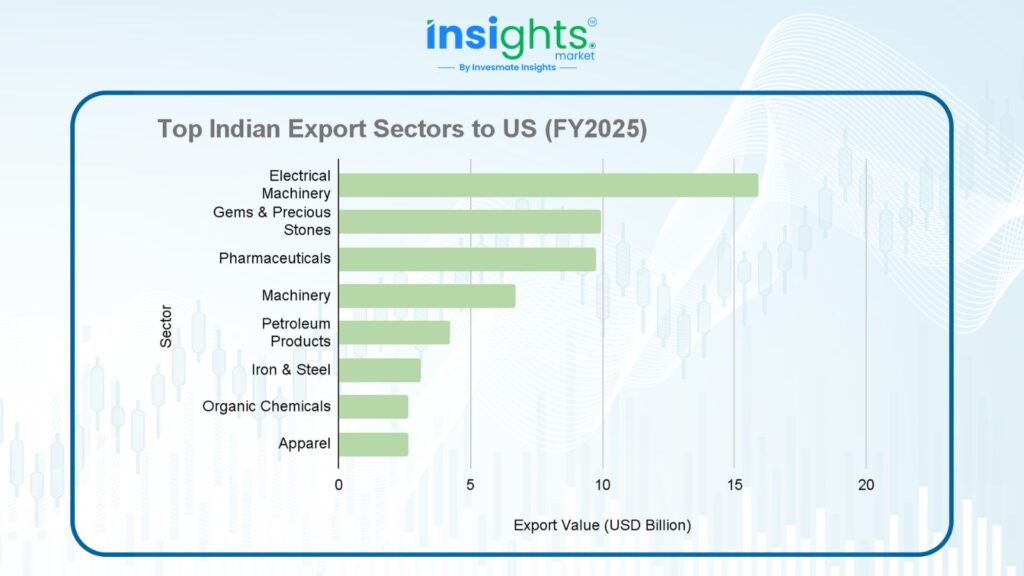
Not all sectors faced the same pain—or stand to gain equally from this deal.
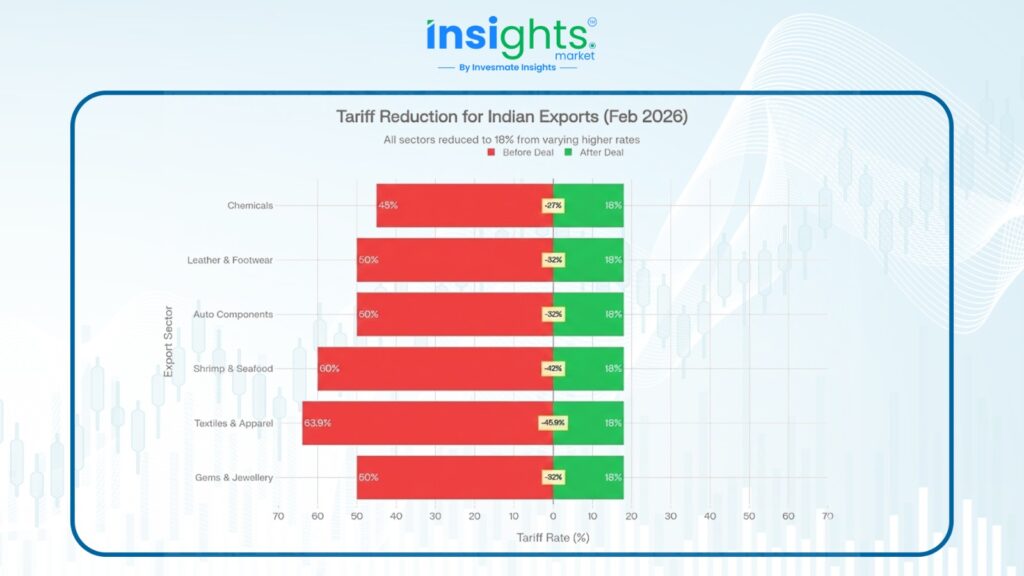
Top 8 Indian Export Sectors to US (FY2025): Total Value $86.51 Billion
P.S Based on official announcements and media reports regarding the reduction of tariffs from 50% to 18%, detailed product-wise tariff allocations are yet to be released.
Textiles & Apparel: The Biggest Winner
Pre-deal reality: 63.9% effective tariff (highest among sectors)
Post-deal rate: 18%
Relief magnitude: 45.9 percentage points
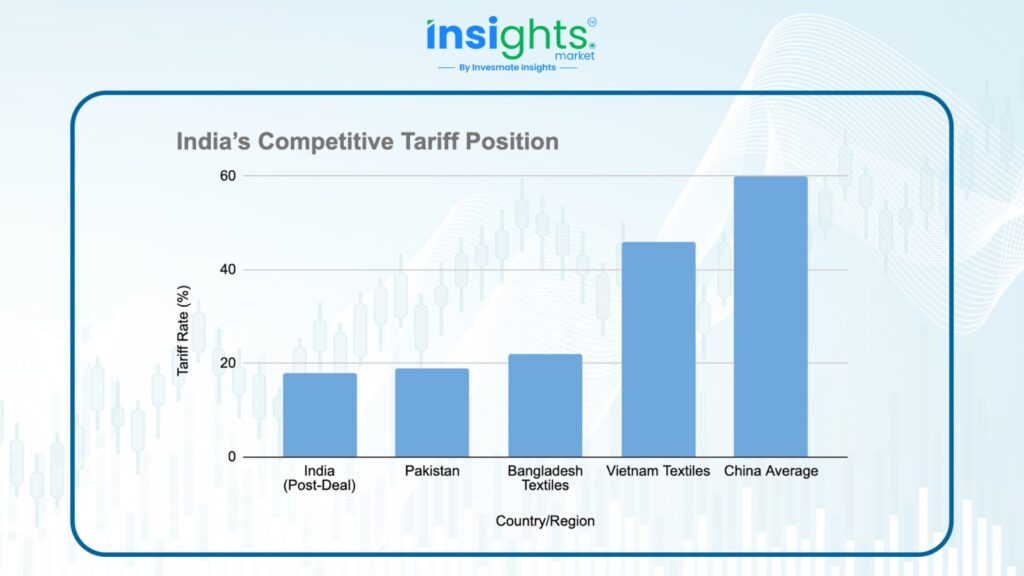
Indian textile exporters ($10.8 billion to the US annually) faced brutal competition. Bangladesh enjoyed 18-25% tariffs while Indian goods carried 64%. Result? Order cancellations, factory closures, and production shifts to Southeast Asia.
What changes now:
- Immediate margin expansion of 300-500 basis points
- Order resumption timeline: 1-2 months
- 1.2 million workers regaining employment over next 6-10 weeks
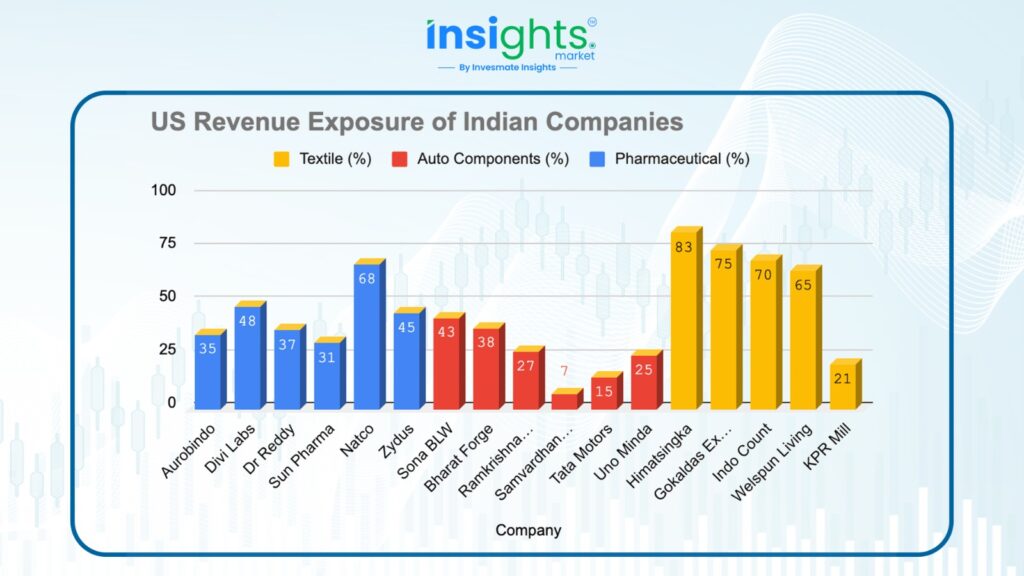
Companies might get benefits: Gokaldas Exports (75.4% US revenue), Himatsingka Seide (83%), Welspun Living (65%), Indo Count (70%)
Gems & Jewellery: From Crisis to Recovery
Pre-deal: 50% tariff
Post-deal: 18%
Relief: 32 percentage points
Surat processes 80% of the world’s diamonds. The 50% tariff decimated US demand—India’s largest market for gems ($10 billion annually). Exports collapsed 40% between April and September 2025.
What changes now:
- Recovery timeline: 6-8 weeks for new orders
- Employment restoration for 1.7 million workers in the sector
- Alternative markets (UAE, Hong Kong) will remain, but US regains primacy
Companies might get benefits: Titan Company, Kalyan Jewellers, Rajesh Exports
Auto Components: Supply Chains Get Oxygen
Pre-deal: 50% tariff
Post-deal: 18%
Relief: 32 percentage points
Indian auto parts exporters ($3 billion to US) serve Caterpillar, John Deere, Volvo—OEMs who demand precision and just-in-time delivery. The 50% tariff threatened permanent supply chain relocation to Mexico.
What changes now:
- New contract timelines: 2-4 months for sourcing decisions
- Margin recovery: 200-400 basis points
- Competitive positioning restored vs. Mexico (10% under USMCA)
Companies might get benefits: Sona BLW (43% US revenue), Bharat Forge (38%), Ramkrishna Forgings (27%), Samvardhana Motherson
Pharmaceuticals: Uncertainty Removed
Pre-deal: Exempt from tariffs
Post-deal: Still exempt—but now officially secure
Indian pharma ($9.78 billion to US) was never hit by tariffs, but lived under the shadow of potential future levies. The deal removes that uncertainty premium, enabling investments and capacity expansions.
Companiesmight get benefits: Aurobindo Pharma, Divi’s Labs, Dr. Reddy’s, Sun Pharma, Natco (all have 30-68% US revenue exposure)
Chemicals & Specialty Chemicals: Margin Pressure Eases
Pre-deal: Up to 45–50% effective tariff
Post-deal: 18%
Relief: ~27–32 percentage points
Indian specialty chemical exporters supply intermediates, agrochemicals, and performance materials to US manufacturers. High tariffs had hurt competitiveness, causing pricing pressure and delayed orders.
What changes now:
- Better export pricing power
- Resumption of long-term US sourcing contracts
- Margin recovery for US-focused players
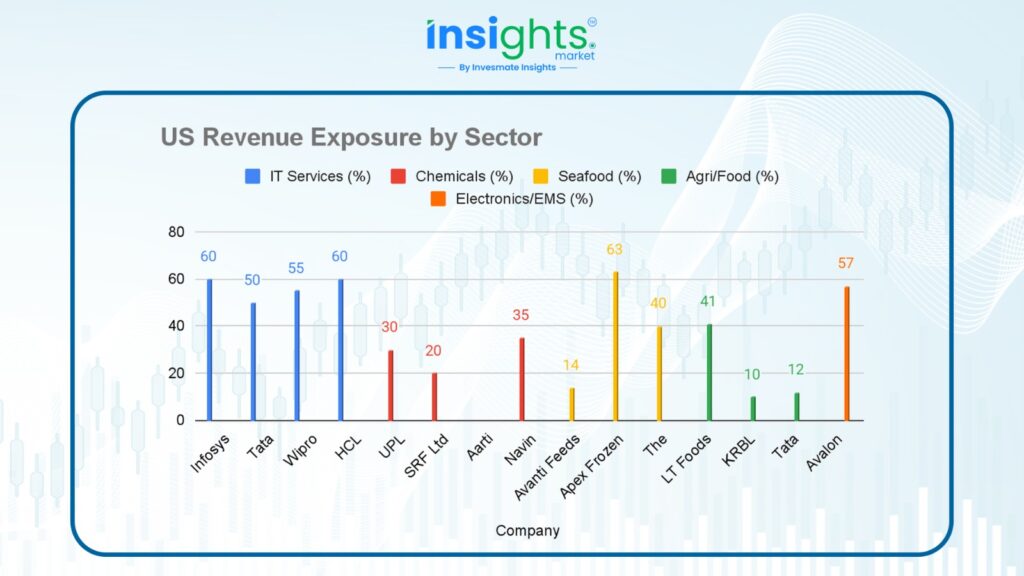
Companies that might benefit: UPL, SRF, Aarti Industries, Navin Fluorine International
Seafood & Shrimp Exporters: Demand Revival Ahead
Pre-deal: Up to 50–60% tariff burden
Post-deal: 18%
Relief: ~32–42 percentage points
The US is a key market for Indian shrimp and seafood. Higher tariffs had reduced competitiveness versus Latin American and Southeast Asian exporters.
What changes now:
- Faster recovery in US import demand
- Better realizations and farm-level pricing
- Inventory overhang likely to ease
Companies that might benefit: Avanti Feeds, Apex Frozen Foods, The Waterbase
Electronics & EMS: Export Opportunity Expands
Pre-deal: Tariff uncertainty and higher duties
Post-deal: 18%
Relief: Improved competitiveness for US-bound electronics exports
India’s EMS sector was scaling exports as part of the China-plus-one shift, but tariffs slowed momentum.
What changes now:
- US sourcing diversification may favor India
- Fresh export orders in electronics and devices
- Improved outlook for capacity expansion
Companies that might benefit: Avalon Technologies, Dixon Technologies
IT Services: Sentiment and Spending Boost
IT services were not directly tariffed, but trade tensions had made US clients cautious on tech spending.
What changes now:
- Greater confidence in long-term outsourcing contracts
- Better deal pipeline visibility
- Possible revival in discretionary tech spending
Companies that might benefit: Infosys, TCS, Wipro, HCL Technologies
Agriculture & Food Exports: Steady Demand, Better Margins
Pre-deal: Tariff pressure and trade uncertainty
Post-deal: 18%
Relief: Improved competitiveness in the US market
The US is an important destination for basmati rice and specialty food exports. Tariff uncertainty had delayed buying decisions.
What changes now:
- Better export realizations
- Stronger demand visibility via forward contracts
- Margin recovery after recent pressure
Companies that might benefit: LT Foods, KRBL, Tata Consumer Products
The Trade-Off Nobody's Talking About
India’s energy shift is not a hard stop, and it’s definitely not simple.
Despite headlines around India diversifying oil sources after the recent US–India trade deal, Russia has publicly stated that oil trade with India remains stable and intact. Moscow clarified that India has always sourced crude from multiple countries, and diversification does not equal an abrupt exit from Russian supply.
So what’s actually happening?
The Reality Behind the Numbers
India is reducing dependence, not eliminating Russian crude.
Recent trend:
- Indian imports of Russian oil fell about 12% in January 2026 compared to December
- Even after the decline, India still imported ~1.215 million barrels per day from Russia — a very significant volume
This suggests adjustment, not disengagement.
Why India Can’t Fully Replace Russian Oil (Yet)
While India is exploring alternatives like Middle Eastern and even Venezuelan crude, those sources cannot fully replace Russian supply in the near term — either due to volume limitations, logistics, or refining compatibility.
Crucially, Indian refiners have not been officially instructed to stop Russian purchases. Buying decisions remain commercially driven.
So Where’s the Trade-Off?
India is balancing two economic priorities:
Cheaper Energy (Russia)
Russian crude typically trades at a $5–7 per barrel discount to Brent.
At previous peak import levels (~1.4 million barrels/day), that discount translated into billions in annual savings.
But as imports gradually moderate:
- Estimated switching cost (if fully replaced): $1.6–2.7 billion annually
- Consumer impact: Potential 0.5–1% increase in fuel prices
However, India is not absorbing this cost blindly.
Protecting Export Earnings (United States Trade Deal)
India stands to gain $15–16 billion annually from tariff relief tied to approximately $86.5 billion in exports.
Net benefit math still holds:
Even with higher crude costs, India could be $13–14 billion better off annually.
Translation:
India is not abandoning Russian oil under pressure — it is carefully reducing risk exposure while protecting a much larger export engine.
Economically rational. Politically delicate. Strategically flexible.
Energy & Oil Marketing: The Hidden Risk of the Deal
The shift isn’t binary, but cost pressures are slowly rising.
Pre-Deal
India imported large volumes of discounted Russian crude, helping:
- Keep refining input costs lower
- Support fuel price stability
- Protect marketing margins
Post-Deal (Emerging Phase)
India is gradually diversifying crude sources, increasing exposure to:
- US crude
- Middle Eastern benchmarks
These barrels typically come at higher and more volatile pricing.
What Changes Now
- Refining margins could face periodic pressure if discounted Russian flows reduce further
- Oil marketing companies may find it harder to fully pass on higher fuel costs
- Working capital requirements may rise with higher average import bills
- Sector performance may lag export-driven industries benefiting from tariff relief
Companies That May Face Pressure
- Indian Oil Corporation (IOC)
- Bharat Petroleum Corporation (BPCL)
- Hindustan Petroleum Corporation (HPCL)
Impact: Mixed to Negative
The sector benefits from macro stability and continued Russian supply for now, but the direction of travel is toward higher crude procurement costs. That creates a slow-burning margin risk rather than an immediate shock.

Market Implications: What Investors Are Watching
Immediate reaction (Feb 2-3):
- GIFT Nifty: +800 points (+3.2%)
- ADRs: Infosys +6.55%, Wipro +3.36%, ICICI +4.17%
- Nifty 50 (Feb 3 close): 10,232.25 (+1.82%)
Sector Moves on Feb 3 (First Trading Day After the Deal)
- Pharma (+3.02%) led gains as policy certainty improved despite earlier tariff exemption.
- Energy (+3.02%) rose on economic optimism, even as oil cost concerns linger.
- Auto (+2.81%) benefited from export relief and domestic growth hopes.
- IT (+1.41%) saw modest gains since services were never directly tariffed.
Sectors to Watch (3–6 Months)
- Textiles: +20–30% potential upside
- Auto Components: +15–25%
- Gems & Jewellery: +15–20%
Key Watch Points Ahead
- Export order trends in textiles and gems
- Q4 FY26 earnings guidance revisions
- Progress on Russian oil substitution
What Happens Next
The deal announced last night is not just about cutting tariffs — it sets the stage for broader economic impact in the months ahead.
Here’s what to watch:
- Exports: Lower tariffs can help Indian companies regain competitiveness in the US market
- Corporate earnings: Better export realizations may gradually improve profit margins
- Domestic demand: Supportive policies like tax relief and easier credit can boost spending and investment at home
- Business confidence: Greater trade clarity allows companies to plan hiring, expansion, and capex more confidently
- Market focus: Investors will track order flows, margin trends, and management guidance in upcoming quarters
The effects won’t show up overnight in official data, but the direction has shifted from uncertainty toward recovery.
The Bottom Line
The US–India trade deal isn’t just a diplomatic win — it’s an economic lifeline for millions of workers and hundreds of companies that spent 10 months under one of the harshest tariff regimes in recent memory.
For investors, this means earnings visibility is returning to export-focused sectors. Companies with 40–80% US revenue exposure, once trading at distressed valuations, now have space to plan and grow.
But the deal also brings trade-offs. India’s commitment to $500 billion in US purchases and its shift away from Russian oil carries execution risks. Energy costs could rise, agricultural sensitivities may surface, and non-tariff barriers will still need negotiation.
The agreement doesn’t remove challenges — it replaces a severe problem with a more manageable one. And in markets, certainty itself is powerful.
For sectors that were under extreme pressure, February 2, 2026 marks the turning point.
FAQs
The US and India agreed to reduce the reciprocal tariff on Indian goods from 25% to 18% and eliminated the additional 25% penalty imposed on Russian oil purchases—bringing the total effective tariff from 50% down to 18%. In exchange, India committed to halt Russian crude oil imports and purchase $500+ billion in US goods over the next five years across energy, technology, agriculture, and defense sectors.
Textiles and apparel ($10.8 billion exports) face the largest tariff relief at 45.9 percentage points, followed by gems & jewellery ($10 billion), shrimp/seafood ($2.4 billion), and auto components ($3 billion). Pharmaceuticals remain exempt from tariffs but benefit from uncertainty removal. Export-oriented sectors with 50%+ US revenue exposure stand to see the most immediate earnings expansion.
Export-dependent sectors are expected to see 15-30% gains over 3-6 months as margins expand and order books refill. High-exposure companies like Gokaldas Exports (75.4% US revenue), Himatsingka Seide (83%), Sona BLW (43%), and Natco Pharma (68%) stand to benefit most. However, JP Morgan notes that broader market returns will likely remain anchored to nominal GDP growth, so sector selection matters more than a broad rally.
Shifting from Russian crude (discounted at $5-7/barrel cheaper than alternatives) to US or Venezuelan oil will cost India approximately $1.6-2.7 billion annually in higher energy import bills, translating to a potential 0.5-1% increase in fuel prices domestically. However, this is offset by ~$15-16 billion in annual tariff relief on $86.5 billion in exports, creating a net economic benefit of roughly $13-14 billion per year.
The immediate recovery timeline varies by sector: seafood and shrimp will show improvements within 3-4 weeks, textiles within 1-2 months, gems & jewellery within 6-8 weeks, and auto components within 2-4 months. Earnings impact will start becoming visible in Q4 FY26 results (Jan–Mar 2026) for fast-moving sectors, with broader margin expansion visible in Q1 FY27 earnings (April–June 2026).
While the tariff reduction is immediate, implementation faces risks: India must actually execute the $500 billion purchase commitment (which may fall short due to market conditions), eliminate non-tariff barriers (requiring regulatory changes), and transition completely away from Russian oil (facing logistical and refinery adjustment challenges). Additionally, global demand conditions and currency movements could dampen the expected recovery. The deal is positive, but not a guaranteed earnings catalyst for all sectors.
This analysis is for informational purposes only and does not constitute investment advice. Readers should conduct their own due diligence or consult financial advisors before making investment decisions.